
Bogotá: On Touching Hearts
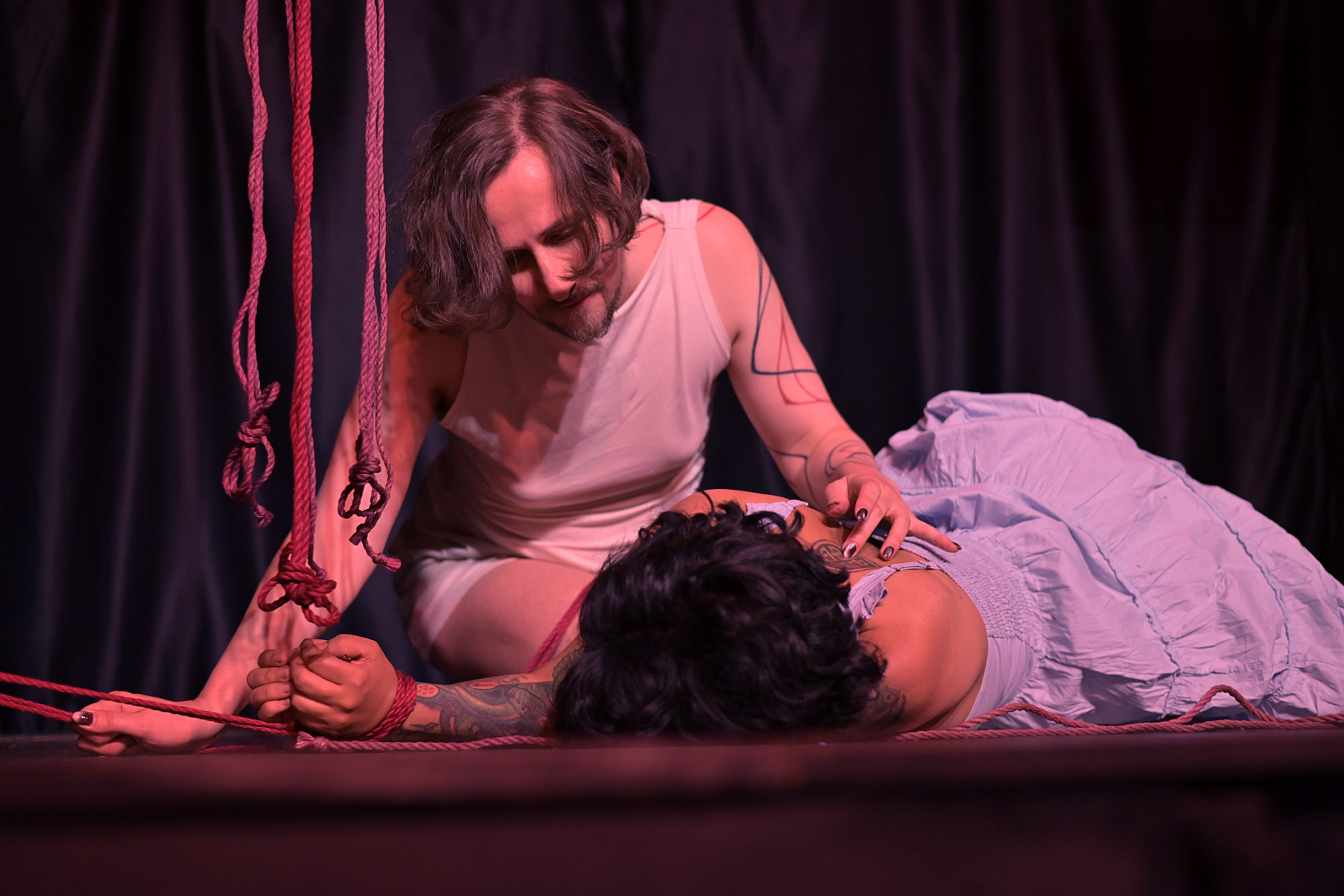
I arrived at El Dorado, the Bogotá Airport at four in the morning. Tired and stressed and wrung out from the flight and the past months. At 1pm it began with a panel talk to introduce the IV Shibari Week Bogotá. Directly after there was the Varieté, a shibari performance night. I was supposed to do the last performance with Liebre Azul, my tying partner from Colombia whom I had never met in person before.
Before our performance we had only half an hour to find out whether we could understand each other. Not in words, but in movement, in rope, in whatever happens between two bodies during a rope performance.
At the end of the fourth Bogotá Shibari Week I was left feeling more affirmed in my rope practice than I have ever felt before. It took me some days and reflections to understand why.
I Arrived With Doubts
After being invited by Shibari Night, I was doubting if I belonged at the front of such a festival. They had invited me as the international special guest, and a quiet voice in my mind kept asking what I could possibly share with these people that they didn’t already know. What I could bring that’s uniquely mine.
The festival’s theme was silent conversations. And the classes I had planned around it were the hardest thing I could imagine teaching. The fine nuances and the invisible layers of tying. The parts you cannot quite grasp technically, the parts steered by feeling more than by form. I had put together classes I had never taught before, on exactly the thing that resists being taught at all. I did not yet know whether any of it would hold up in front of a room — in a cultural context not my own, about a practice that comes from Japan, not from either of us.
Technique and Feeling
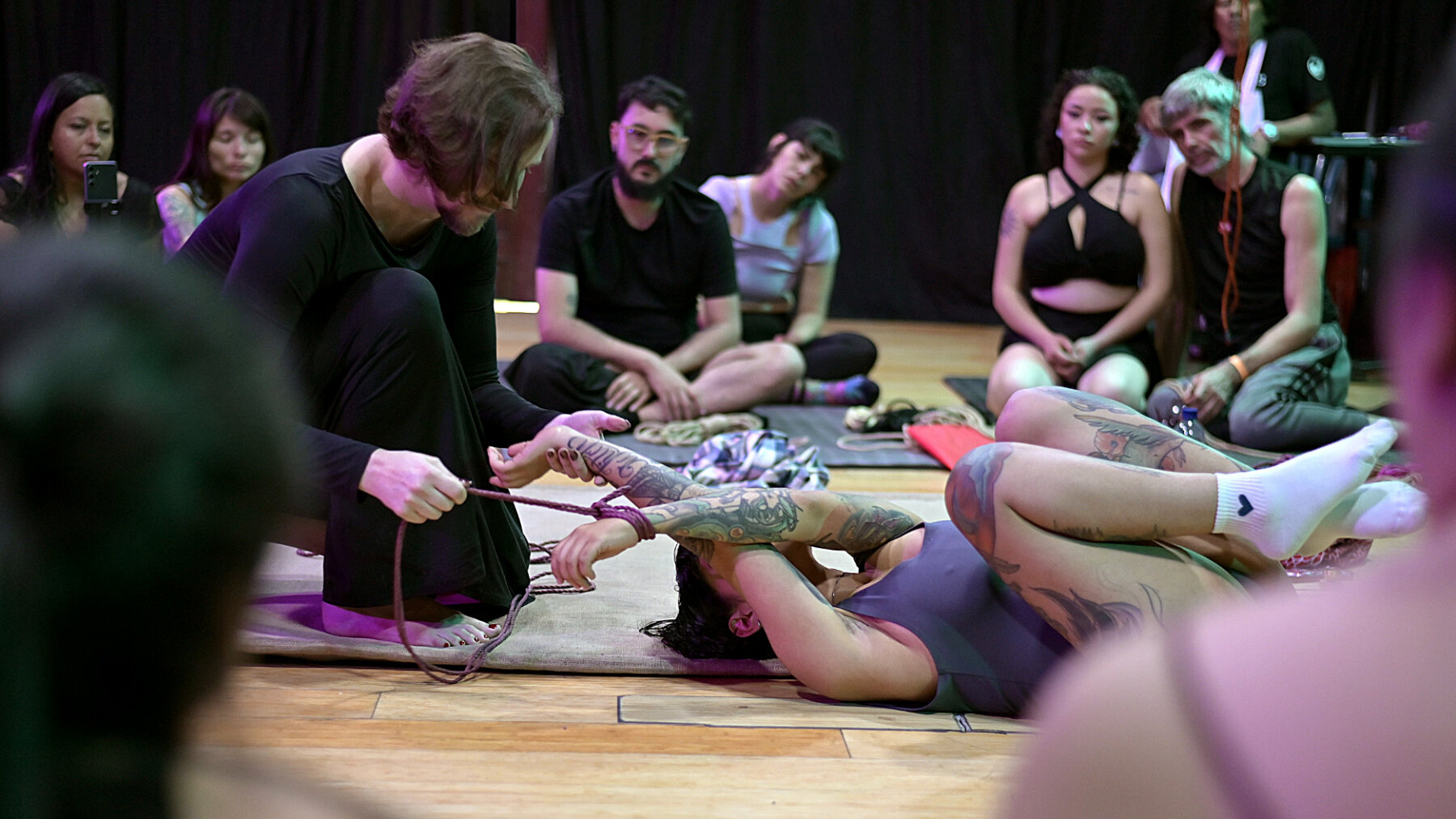
The friction I want to describe is not Colombian, and not European either. It runs through every rope scene I have spent time in. Shibari is an intimate practice that happens (mostly) between two people, and there is a point in many people’s journey where the ego pushes its way into the practice. Where someone wants to prove they are valid, wants to show how good they are, and reaches for technical excellence to do it. Clean lines, correct forms, the purest style, the right vocabulary. And in that reaching, the path of intimacy and often trust gets left behind.
I went to Colombia and recognized my experiences from Europe in some private conversations there. The same two pulls inside the practice. And inside most of us who tie. Almost everyone wants both: the competence and the connection. But people weight them differently, and some lean so far toward technique that rope becomes something to be ranked and earned, while the exchange, the trust, the silent conversation between two bodies slips into the background.
Certificates Don’t Touch Hearts
I do not think the border is drawn out of malice. People pay a lot of money and spend a lot of time to learn this practice, and they want something solid to hold onto. Certification can offer exactly that.
What it quietly assumes is that shibari is a craft whose value lives in correctly executed forms, and that mastery can be ranked, examined, stamped. Learn the patterns, pass the levels, and you are doing it right. Prioritize feeling over form and you are doing something lesser.
I understand the appeal. Technique is teachable and measurable in a way a feeling never is. A solid technique also matters in a practice where so much can go wrong. But I have watched a tool for keeping people physically safe slowly turn into something else: a way of deciding who belongs, the checklist drifting from serving the practice toward policing it.
So my quarrel is not with skill, or with the people who spent years earning it. It is with the moment skill stops being something you learn for the safety of your partner and becomes a badge you have to show at the door.
What gets lost is the part that cannot be certified: presence, the capacity to listen with your hands, the flexibility to get messy, the willingness to not know what comes next.
A Silent Conversation
Azul and I had half an hour. We agreed on a rough outline and had only tied a little, to feel whether we could move together. It was enough to feel confident with each other.
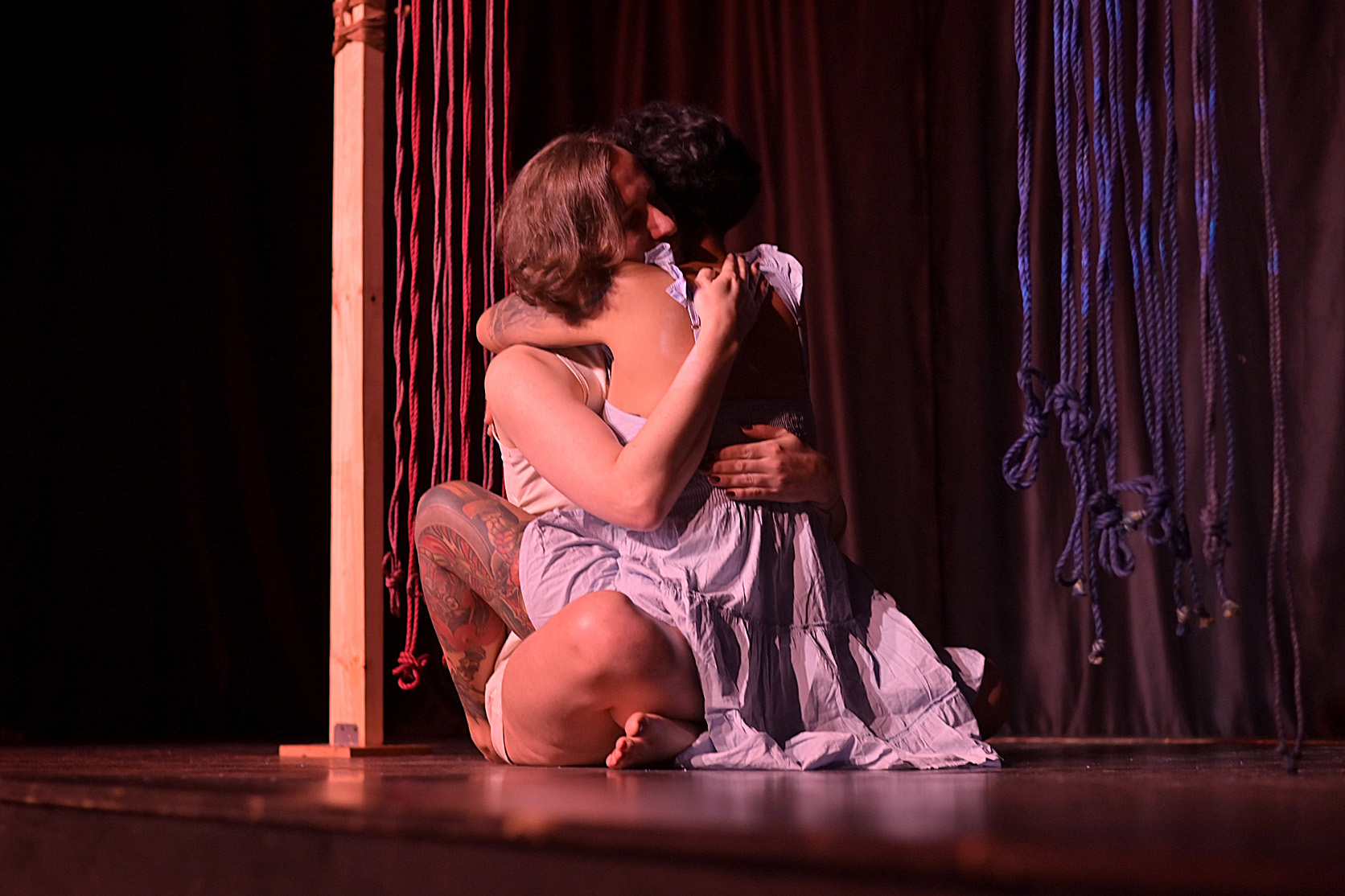
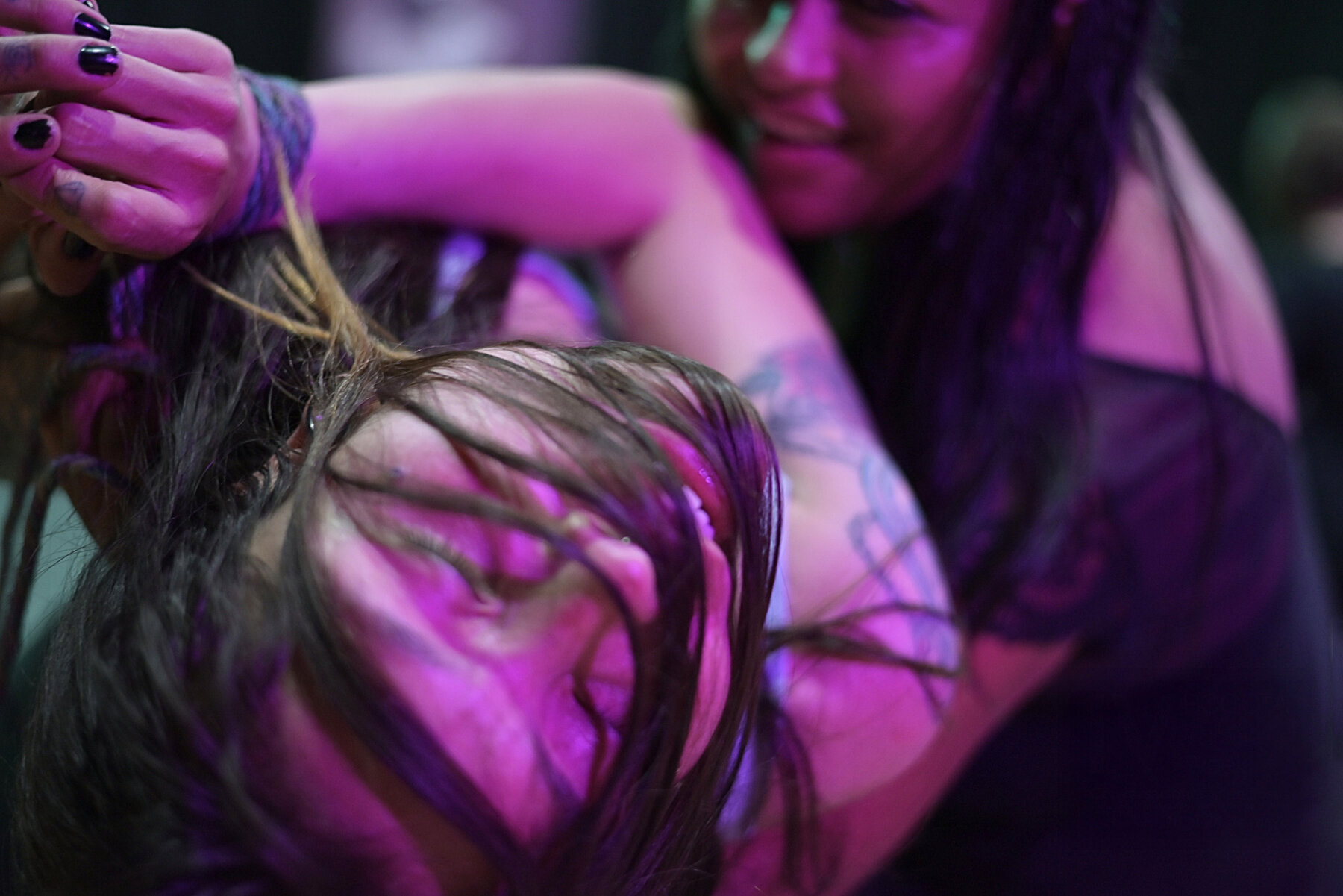
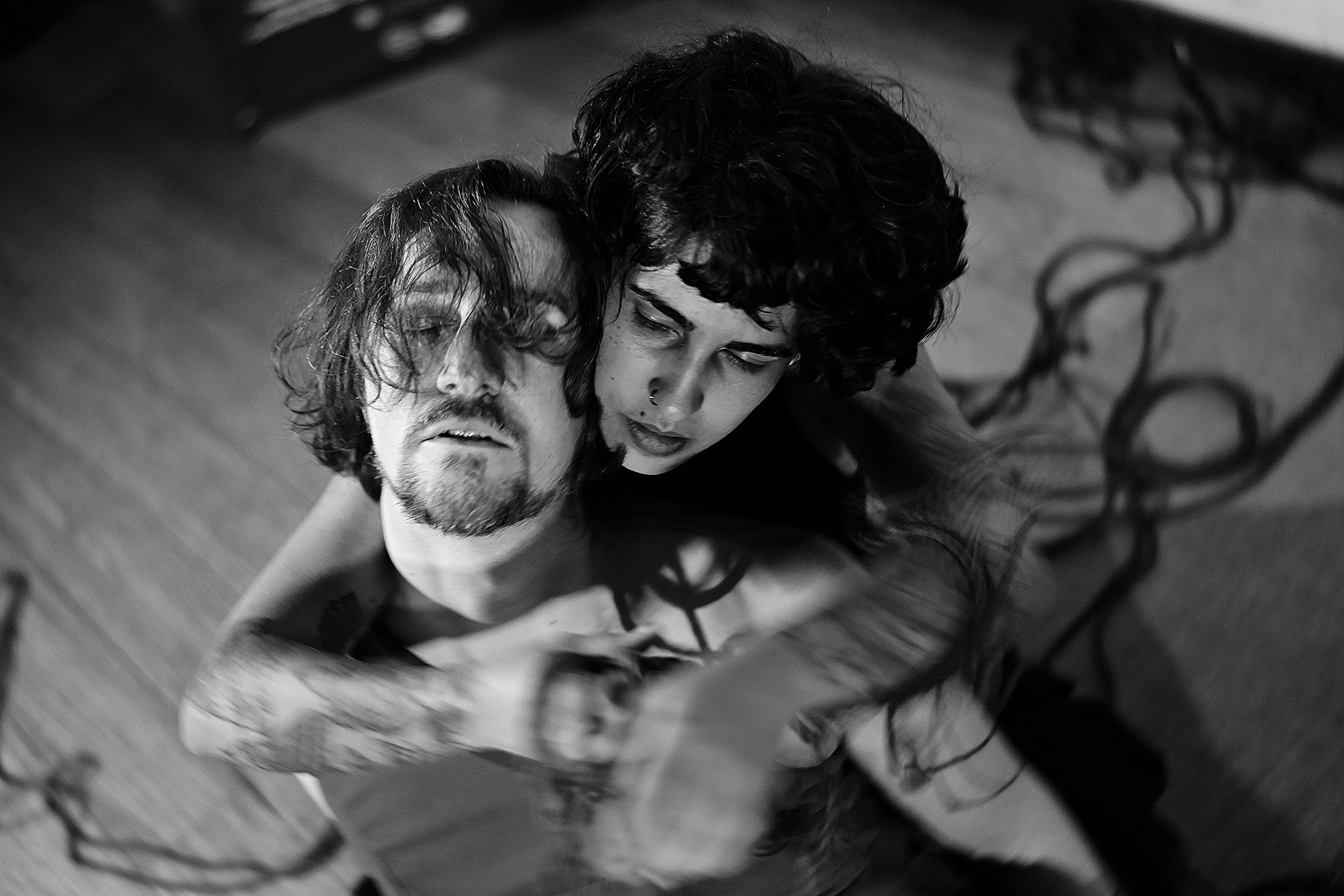
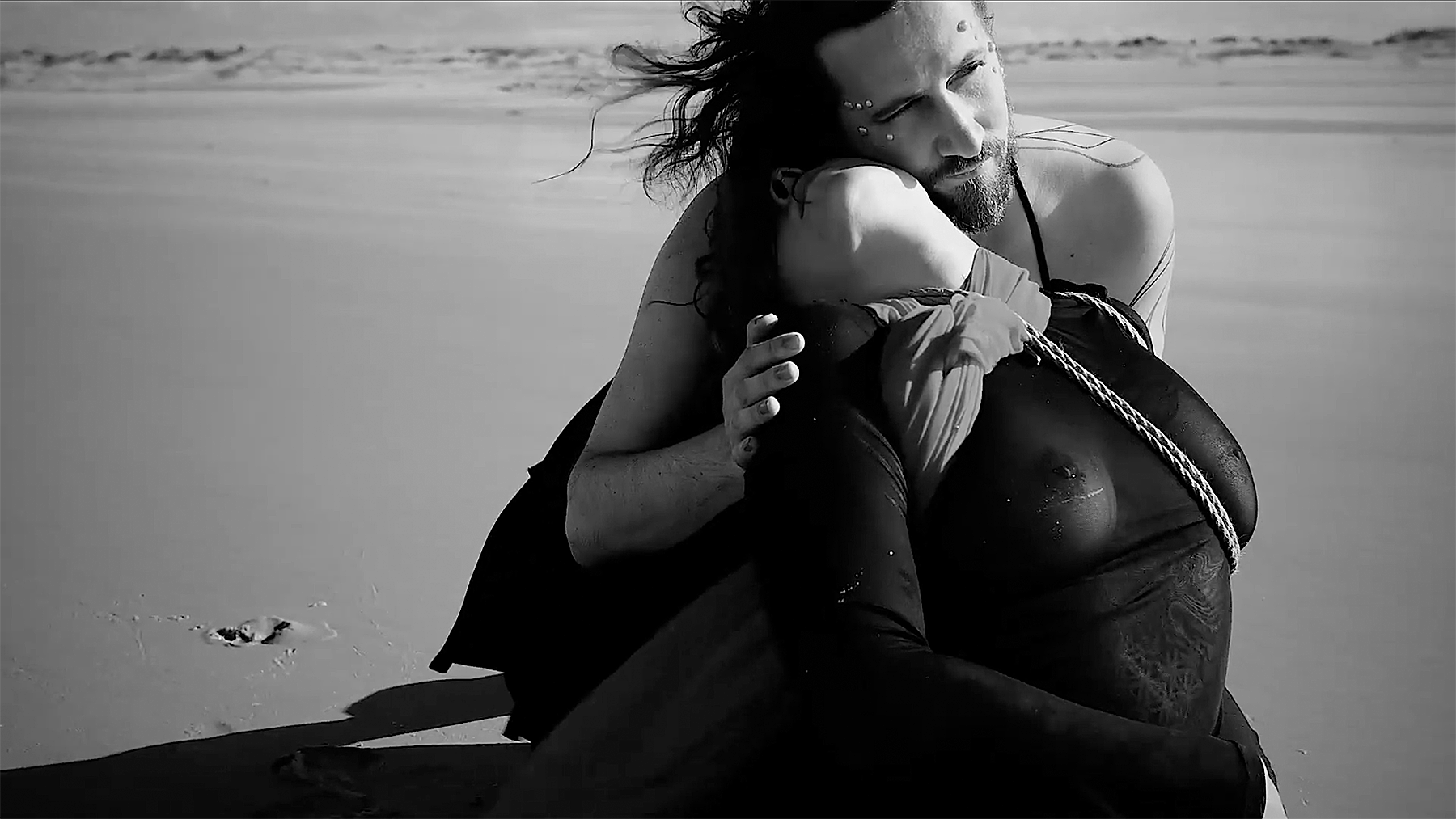
We wanted to open with a statement. Rope performances so often begin the same way. One person seated, the other standing beside them or walking in, the rope present from the first moment. We refused that. Before the curtain opened, we were already on the floor, holding each other in a hug, close like lovers. Calming each other down to get rid of the nervousness.
When the curtain opened, we did not move. We held that position, completely still, for almost three minutes – the length of the short introduction song. As the song ended, we began to move almost in slow motion. It was an intimate moment of exploring each other via movement and touch. Six, maybe seven minutes had passed before we introduced the first rope.
By then the room was already captivated.
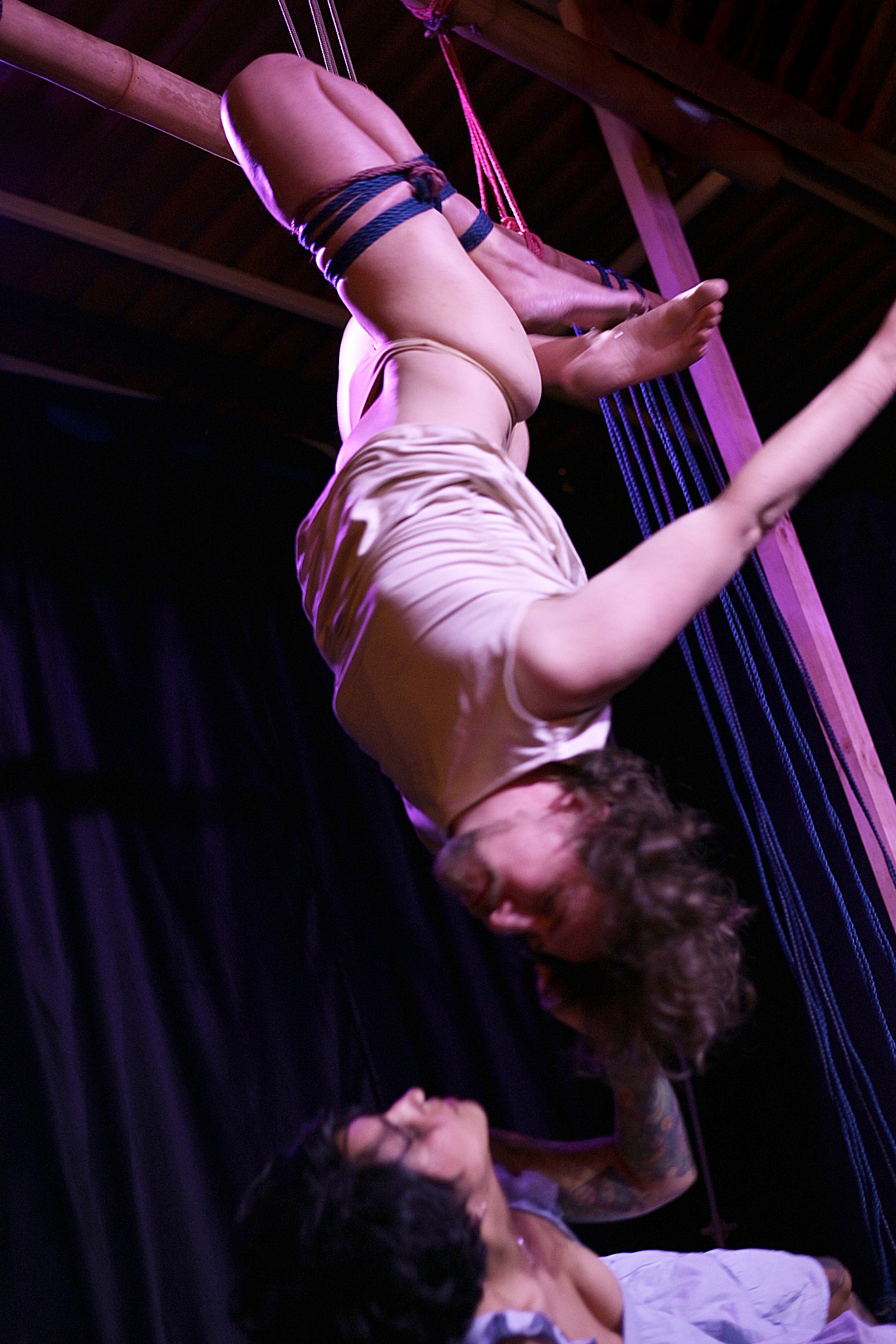
And the performance ended as it had begun: Inverted. Me alone, upside down, hanging from a single futomomo, pulled slowly upward with a pulley system to an instrumental of Space Oddity.
People asked us afterwards how we had managed to rehearse the whole performance in such a short time. We mostly hadn’t. The beginning and the end were planned: the still embrace, the inversion to close. Everything in between had been improvised. No choreography to memorize, no forms to reach for. We simply listened to each other and went with the flow.
A Confirmation From Outside
Through the week I taught four workshops, participated in a photoshoot event, and created a collaborative photo work with the community. People told me that it is rare in Colombia to find rope teachings about the emotional and interpersonal aspects of tying.
In conversations I had the sense of a community that wants exactly this, and that does not always find it easy to claim space for it. I cannot make any claims here, because I only heard it in personal conversations — but the shape felt unmistakable to me. It is the same shape I know from running Karada House.
You build something around the relational side of the practice, and somewhere there is always pressure suggesting that this is not quite the real thing, not quite rigorous enough.
Without intending to, I could offer something that felt to some like a confirmation from outside: the human, relational side is legitimate. You do not have to justify it to anyone. Your heart matters.
The Morning Messages
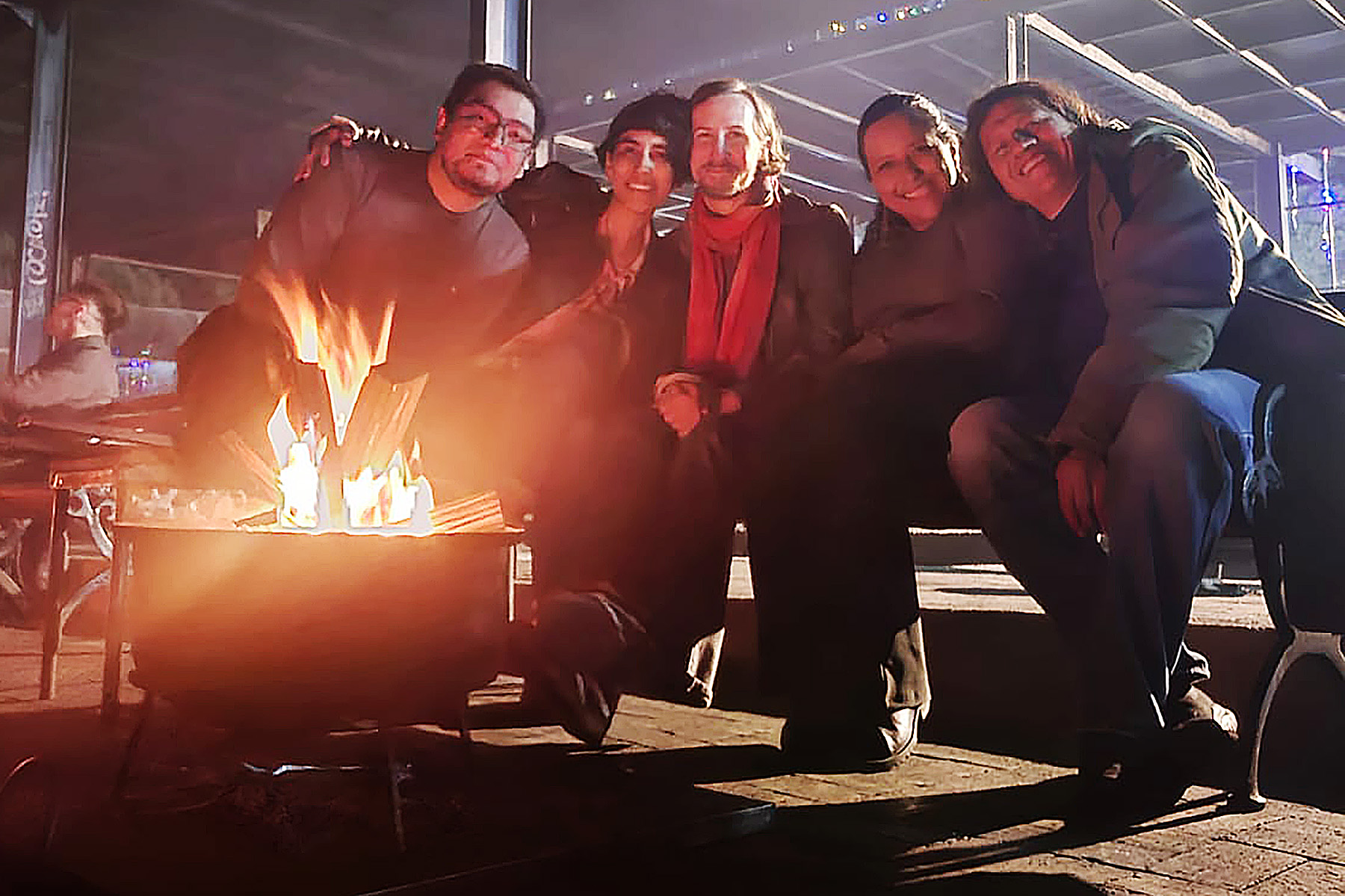
The best way I can describe the warmth of that week is to tell you what happened every morning. I woke up to messages from the organizers. They were mostly not about logistics. These were messages about how the days were going, how their hearts felt. They shared positive feedback from the workshop participants with me. They constantly checked in with me to see how I was doing, asking about my needs. Inquired about my needs. And one message ended simply: “Thank you for giving us part of you.”
That kind of care was far from what I had expected.
I watched the community the same way. The constant checking-in, the way people looked after each other. It was easeful in a way that surprised me, leaving my queer Karada House bubble. Seeing this filled me with some hope.
And on the last day, a fellow queer person came to me in tears, to tell me what those days had given them. By the end, a whole group sat together crying, touched by each other. Very beautiful.
The Open Heart
People are reached when you open your heart, not when you win the argument about what real shibari is. When you share your own way, from passion, instead of reaching for a standard to enforce. Sharing what is yours, giving others space to make it their own, and to disregard what doesn’t make sense to them.
I came to Bogotá with doubts. I left with answers to questions I had not asked. It showed me that you find a place in people’s hearts when you show up with what moves you, and when you leave your ego behind. Open to listen, instead of pretending to have the answers for everything. When I left, I felt that a part of my heart stayed there.
Muchas gracias, Bogotá, sumercé.
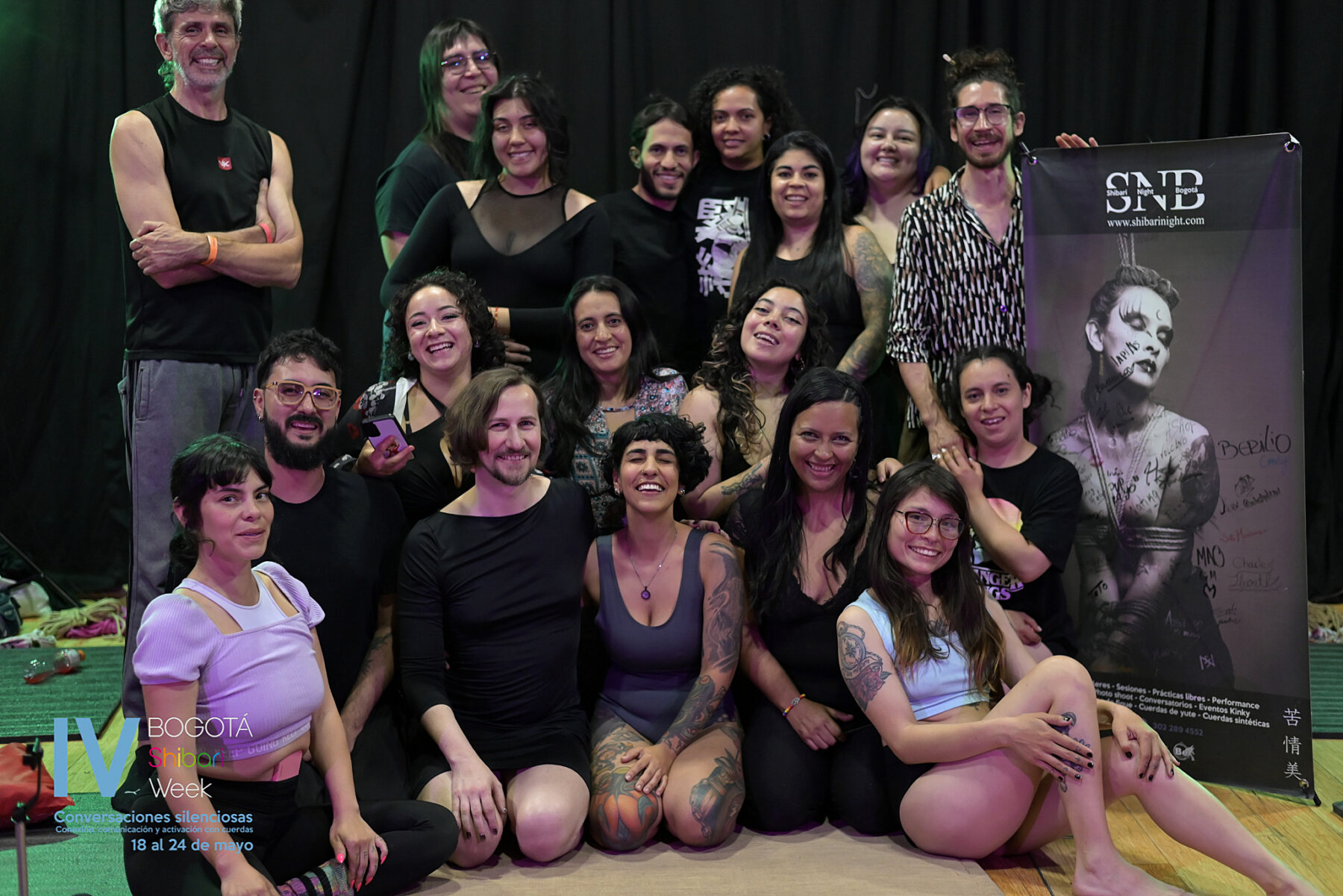
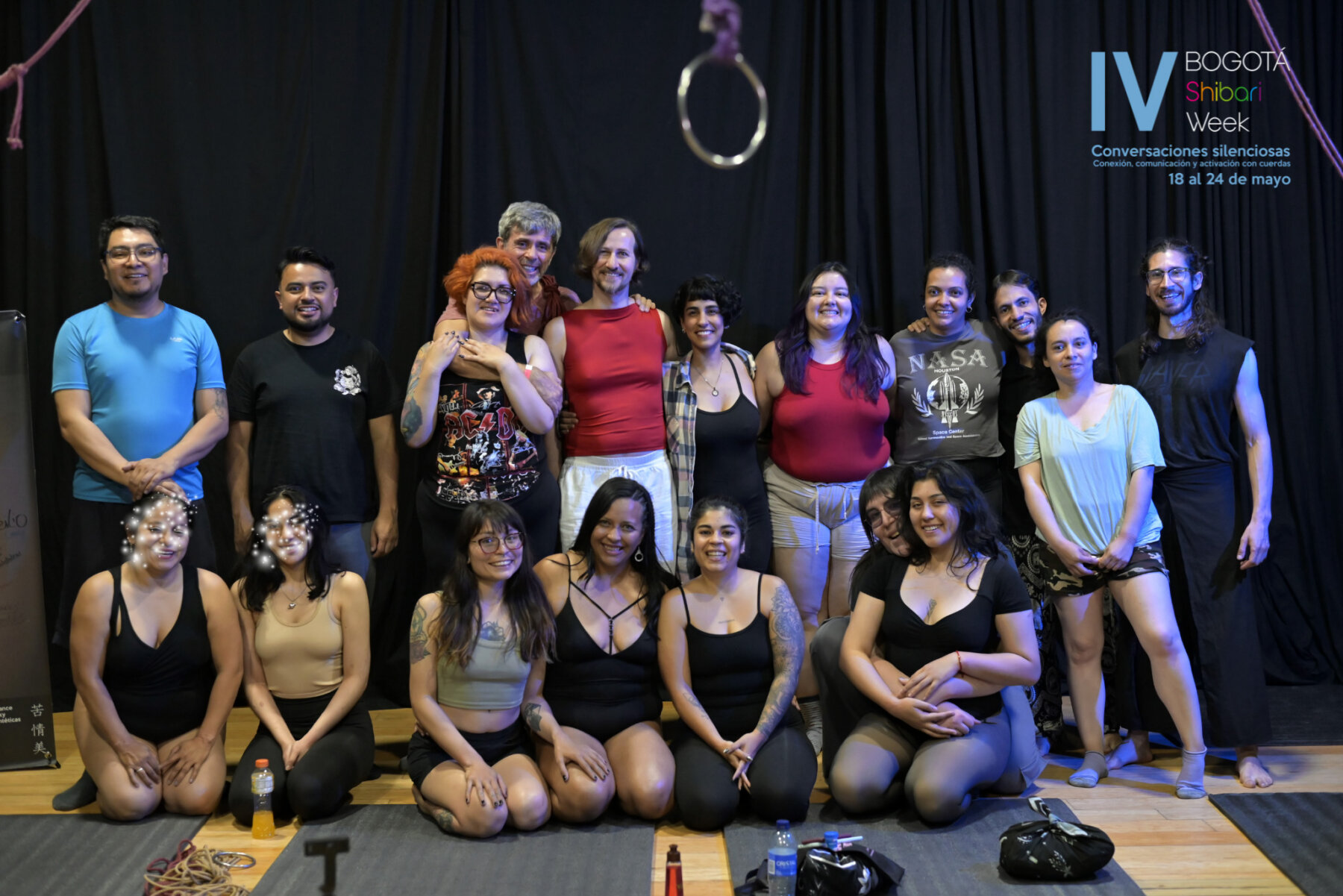
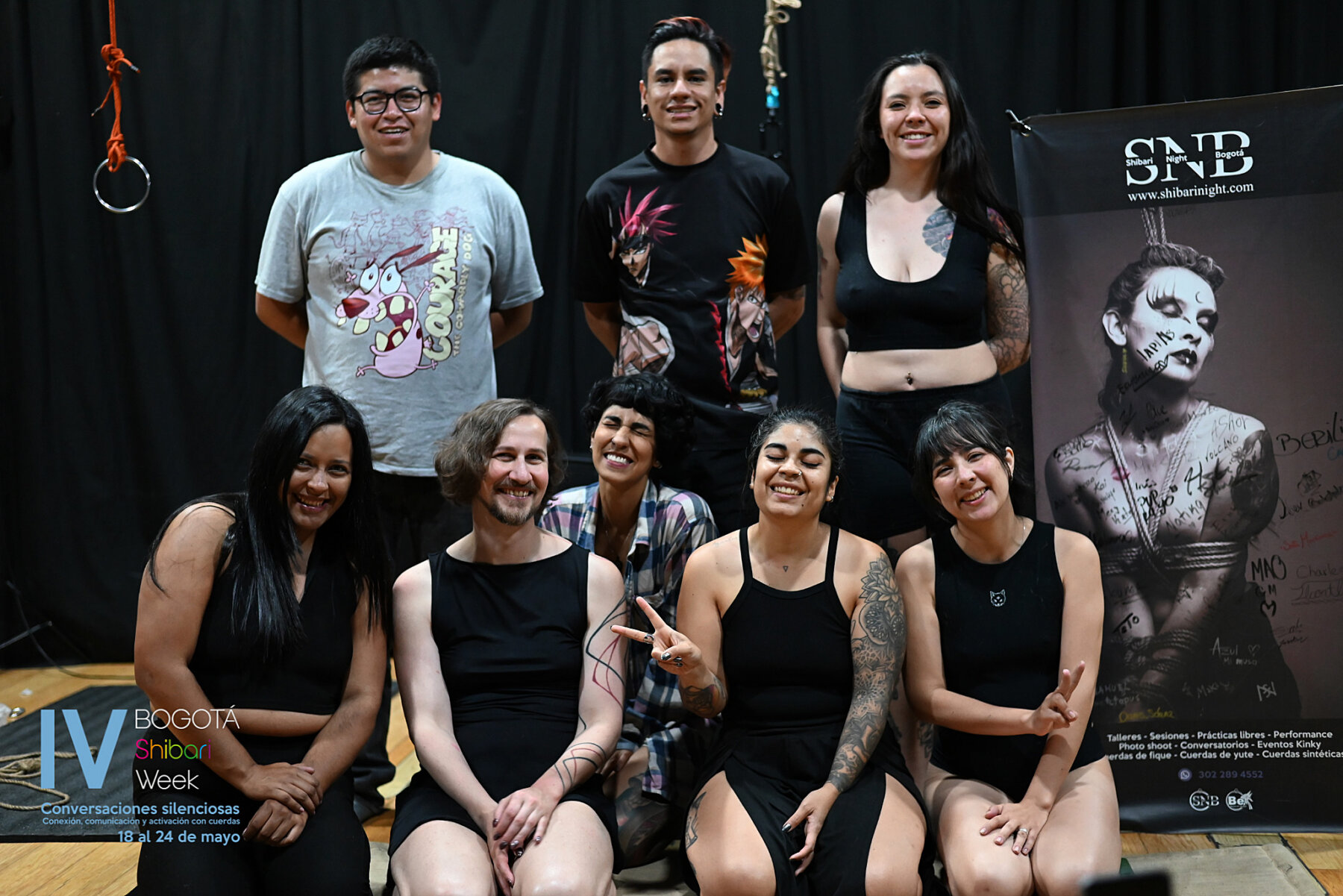
Photo Credits: Charles Ilcoatl & Shibari Night

Who Was Kise Sahara?
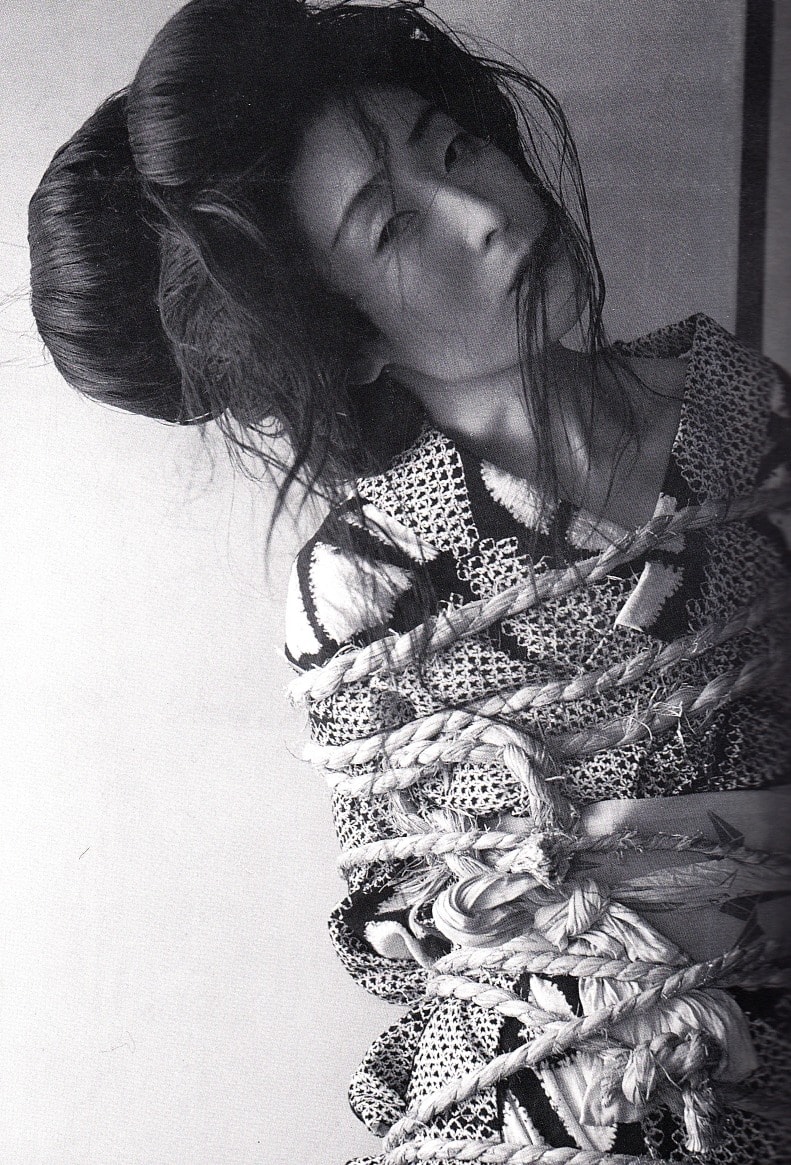
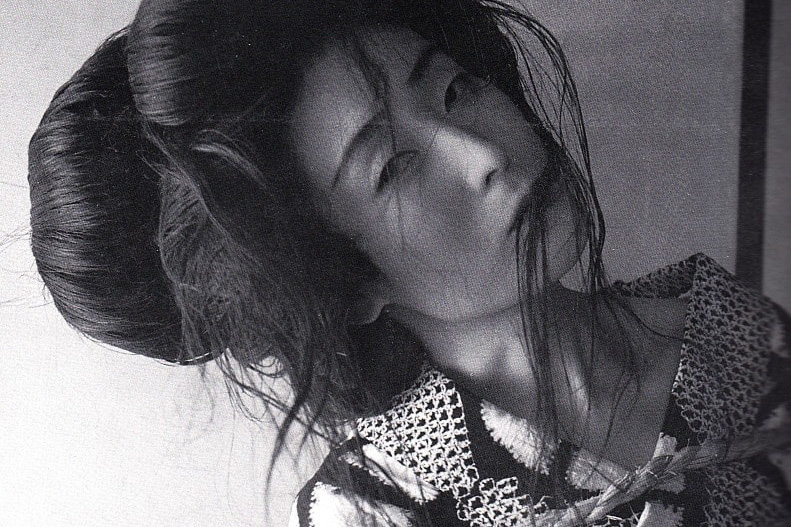
There is a photograph. It is one of the most well-known images in the young history of Kinbaku. A woman, heavily pregnant, being suspended with rope upside down, bound. It was taken in 1921. It is cited, reproduced, and treated as a founding document of an entire practice to this day.
The woman in the photograph is named Kise Sahara.
And that is almost everything we know.
It connects to something I’ve been thinking about for a while. About what gets remembered in this practice, and what disappears. I wrote about it from a different angle in Empty Rope.
What the sources say
Kise Sahara was born sometime between 1893 and 1895. The exact date is unknown. She worked as an actress at the Kaiseiza theater in Tokyo and supplemented her income as a day model, earning 80 sen per day. In 1919, she was introduced to Seiu Ito as a model. That same year they became a couple, she became pregnant, and they married.
In the years that followed, she modeled for snow torture photography, for suspensions, for series that Ito published in magazines and private collections. In June 1921, in her ninth month of pregnancy, she was suspended upside down and photographed. The image is titled Rinketsu Bijin Sakasa Tsuri no Shashin:
“Photograph of a Wife in Inverted Suspension in Her Last Month of Pregnancy.”
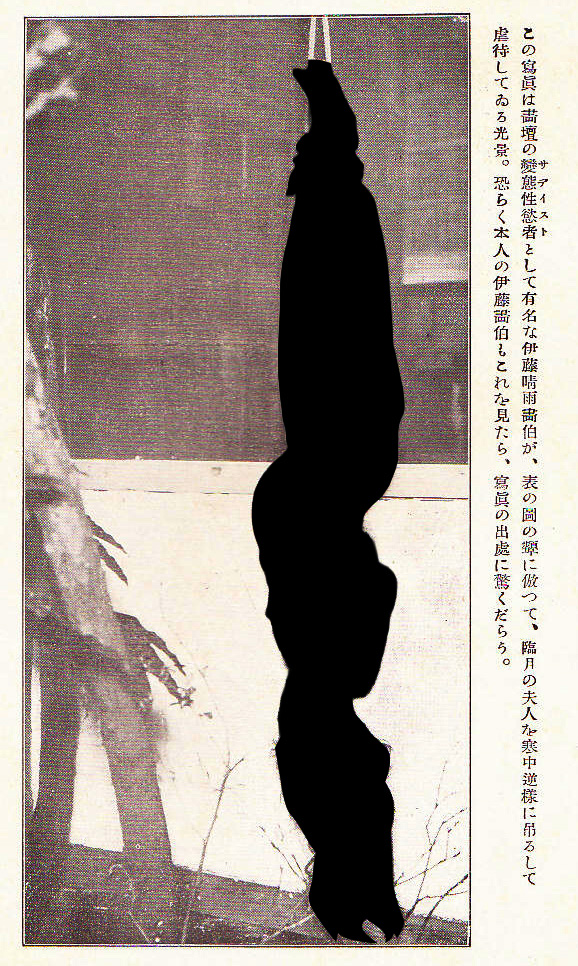
In 1925, she joined a theater troupe and traveled with them to Hokkaido. Ito and she divorced. The Japanese SMpedia source notes this dryly in a footnote: “Later, he cheats on her and leaves her.”
In 1926 – one year after the divorce – the pregnancy suspension photograph appeared without Ito’s permission in the December issue of the magazine Hentai Shiryou. The photograph was published alongside a ukiyo-e print by Tsukioka Yoshitoshi, which Ito had cited as the visual inspiration for his work with Kise Sahara.
After that: nothing. No date of death. No further entry.
Not a single word of her own.
The only source that gives her a page of her own – Nawapedia – relies as its primary source on Seiu Ito’s own article “Various Types of Suspension Torment” (Fuzoku Soshi, January 1954). [Nawapedia: Kise Sahara, source note] We know who Kise Sahara was because her ex-husband wrote about her in an SM magazine thirty years later.
The question of willingness
Wikipedia describes Kise Sahara as having “posed willingly for her husband.” Another source says she “voluntarily posed for Ito.” The framing recurs across descriptions of their collaboration. Consent rendered as settled fact, stated without a source.
The word carries a great deal. It closes a question before it can be asked.
What does willingness mean for a woman who earned 80 sen a day as a day model. In a society in which women had almost no economic independence? What does it mean for a woman who was pregnant by her husband, in a marriage in a higly patriarchal society? What does willingness mean when the alternative – refusal, resistance, her own terms – is not documented, because nobody thought to ask?
I am not raising these questions to claim that Kise Sahara was coerced. I don’t know that. Nobody knows.
No source contains her own account. That is precisely the problem. And it is not only a question about 1921. In the last fifteen years, the international shibari scene has engaged in various serious debates about abuse of power, consent, and the asymmetries between riggers and their tying partners. The account of the person being tied is invoked, in these debates, as central. Non-negotiable. In practice, the record looks different: when someone comes forward, they are often not believed, or ignored, or when the case becomes too visible to dismiss, the rigger takes a two-year pause and returns as though nothing happened. The structure remains intact.
And yet the earliest document of this practice that continues to be reproduced today is one in which we do not have the account of the person being tied. We never asked.
The child
Kise Sahara was photographed in her ninth month of pregnancy. She was heavily pregnant. The child is not mentioned in a single available source. No source says whether the child was born alive. Whether it survived or who raised it. Kise Sahara, who separated from Ito in 1925, or Ito himself, who is recorded in the SMpedia source as the father of at least two children from his first marriage.
According to the Japanese SMpedia source, Ito’s children from his first marriage are recorded by name: a son, Masaaki, and a daughter, Kiku. The child or children from his marriage to Kise Sahara: no name, no mention, no date. A child who, like its mother, does not appear in the record.
Whose story?
The 1921 photograph was published without Kise Sahara’s consent – and without Seiu Ito’s consent. For Ito, the photograph became part of his public identity as an artist and “father of modern kinbaku.” For Kise Sahara, it was an image of her pregnant body that entered public circulation without her knowledge, at a point when she was no longer even his wife.
The sources agree: the image was attributed to Seiu Ito, and he was subsequently labeled hentai. A pervert. Whether and how that label fell on Kise Sahara herself – whose body the image showed – is not documented in any source. The question appears never to have been asked.
Everything we know about Kise Sahara comes from sources written about her, not by her. Her perspective on working with Ito, on the suspensions, on the publication of the photograph, on the divorce: not documented. No letter, no interview, no diary entry. Not even a date of death.
The most well-known image in the early history of kinbaku shows her body, and her name does not appear in any of the established historical maps of shibari’s development and lineages.
Who gets to be remembered
This is a question about structures. About how knowledge is produced, who produces it, and whose experiences are deemed historically relevant. Seiu Ito wrote about his own work. He wrote about his models. He wrote about Kise Sahara. As material, as muse, as part of his artistic development. Those texts were archived, cited, transferred into wikis.
Kise Sahara did not write. Or if she did, no one kept those texts.
The result is a historiography in which one person becomes subject and another becomes object. One person has a biography. The other has a chronology of photo sessions. Logically I can not give any answers. But it ventures to ask questions I have not found asked anywhere else.
Sources
All factual claims in this essay are drawn from the sources listed below.
- Nawapedia: Kise Sahara
- Nawapedia: Seiu Ito
- SMpedia: Seiu Ito
- Wikipedia: Seiu Ito
- Kinbaku Today: “Kise Sahara: The First SM Model in Japan?”
- Pen Magazine Online
Japanese-language primary literature (biographies, magazine articles, newspaper coverage from the 1920s) was not directly accessible to me. All Japanese-language sources were read through machine translation.
Conversaciones Silenciosas
When Bogotá Shibari Week first reached out, they asked me what the festival theme could be. If it were inspired by my work. I made a suggestion. They came back with Conversaciones Silenciosas. Silent Conversations.
It was better than what I had proposed. It named something I’d been circling for a long time.
What do bodies say when words lose their meaning? What conversations happen between tension and release, between tying and being tied? I’ve been asking this for years. In rope, in photography, in film. And now a whole week in Bogotá runs under that exact question.
That made me thoughtful, and got me looking at my own work with different eyes. What am I actually doing here? What do I want to say? What conversations am I trying to have?
And then the other direction: what happens when I bring these questions to Bogotá? To Colombia. To a community I’m still getting to know and curious about. It goes both ways — what I bring, and what I take back. What I learn. Where this practice leads me next.
Where I’ll Be
Varieté: Between Pink & Blue · May 18
A performance collaboration with Azul Ropes on opening night. The title says something about where bodies are allowed to exist — between the colors we’re assigned, in the space that’s supposedly empty.
Opening Conversatorio · May 18
¿Cuerpos que conversan sin palabras? — A panel discussion to open the week.
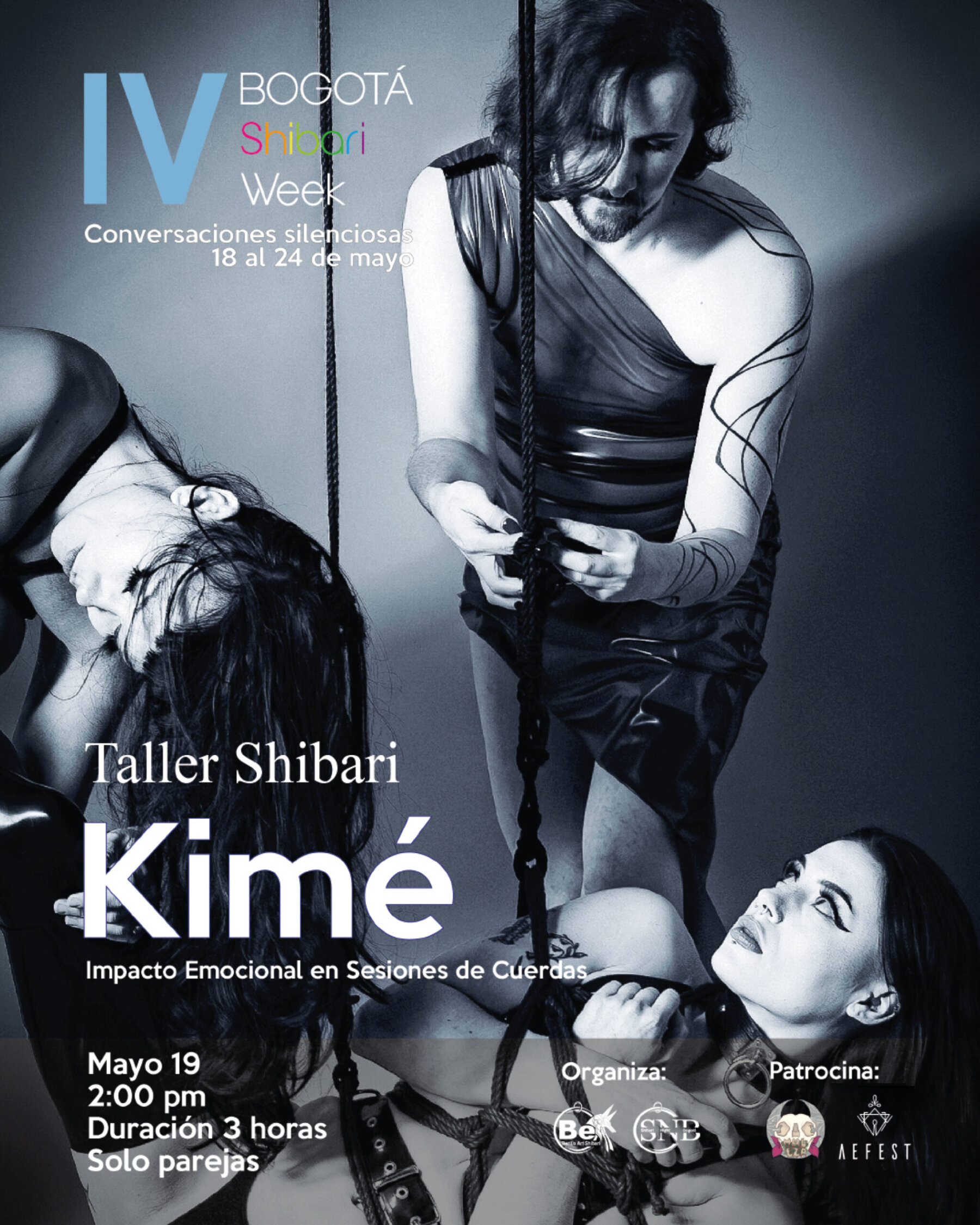
Workshop: Kimé · May 19
Emotional impact in rope sessions. Moments of peak intensity in a session: not necessarily the most extreme physical moment, but the one where something shifts. How do we recognize it? How do we hold it? How do we come back from it?
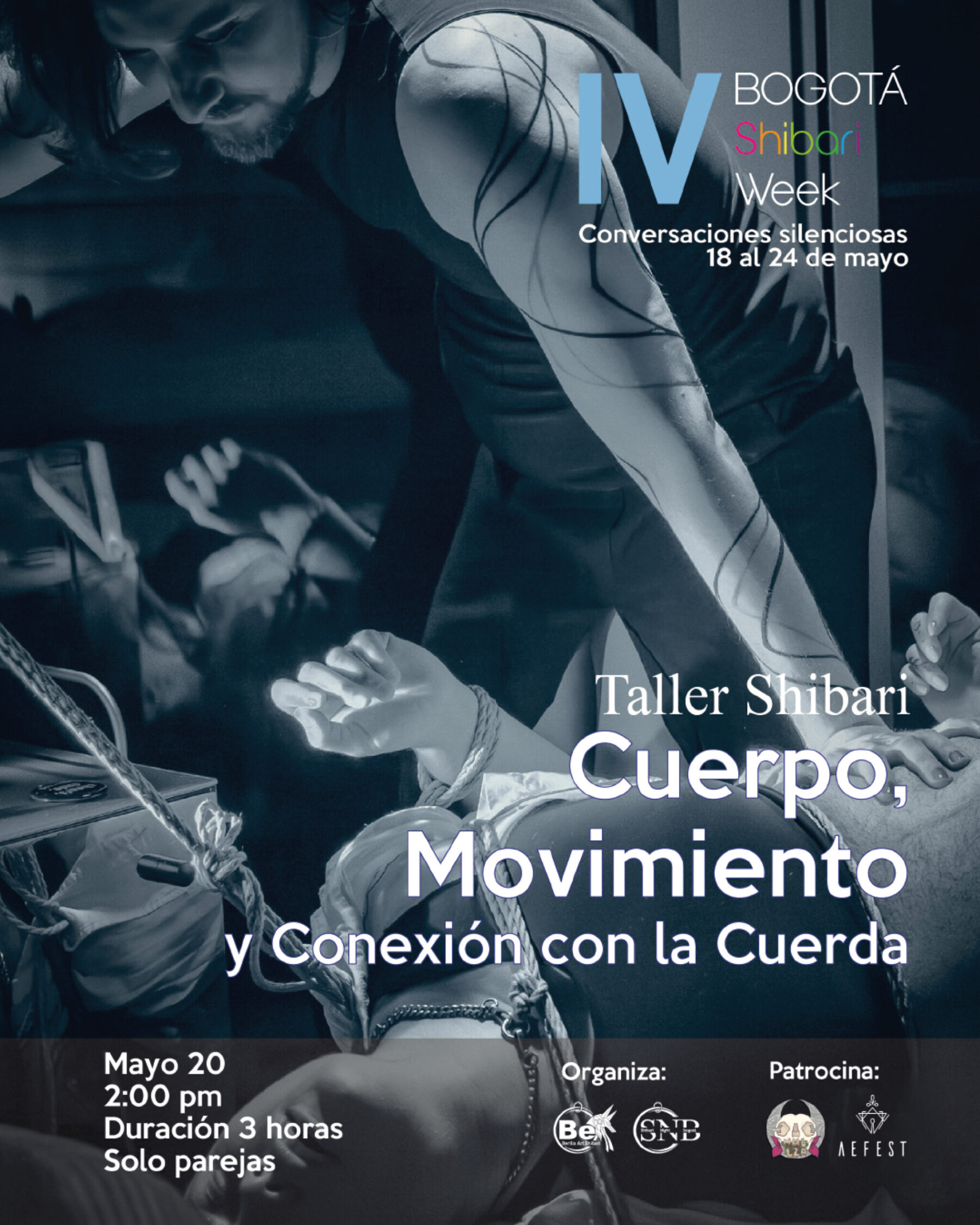
Workshop: Body, Movement & Rope Connection · May 20
Rope as a sensory and relational system. What does it mean to let the rope moves with a body rather than simply constrain it?
Workshop: Edge & Play · May 20
Erotic exploration through rope — for couples.
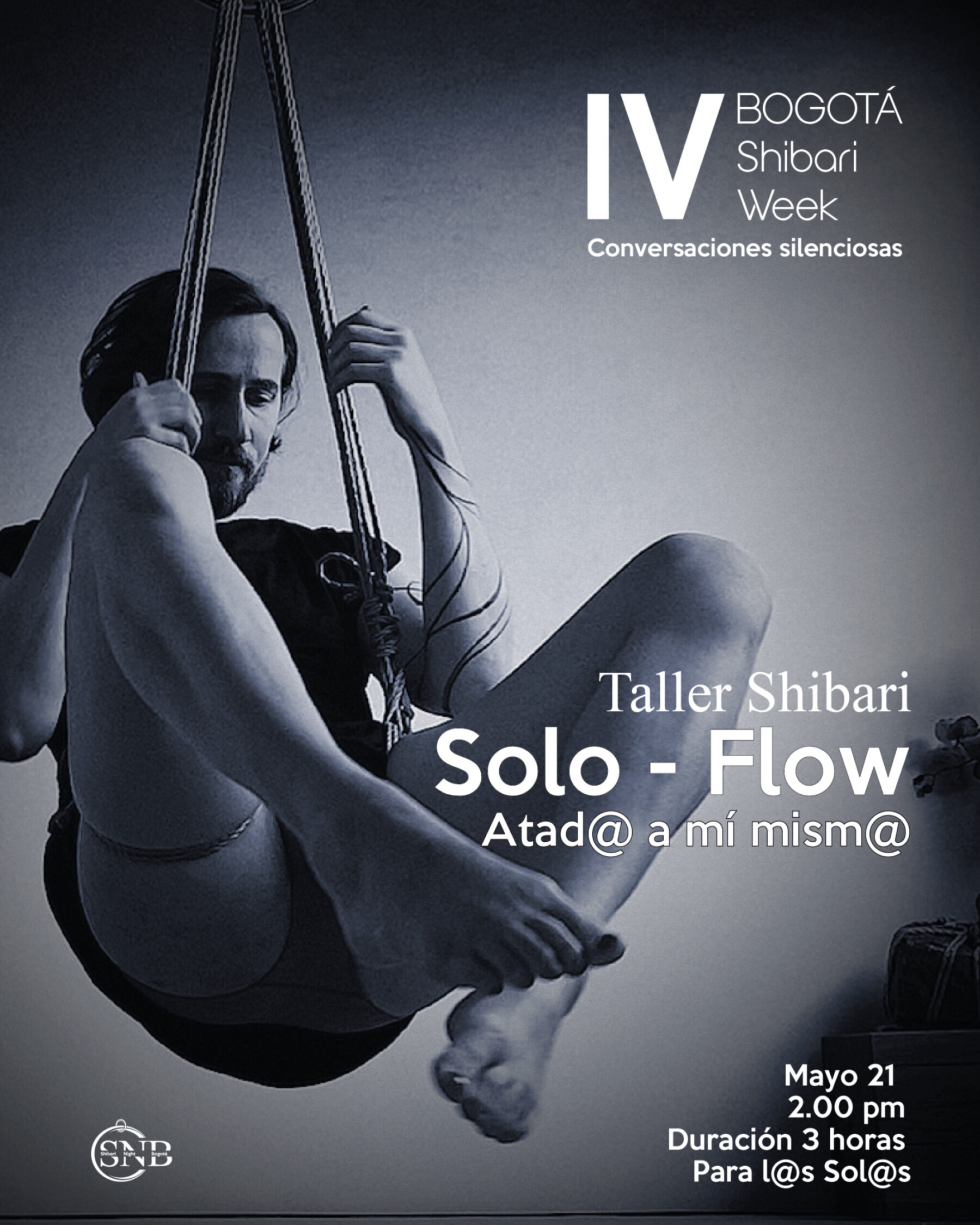
Workshop: Solo-Flow · May 21
Atad@ a mí mism@. Tied to oneself. For participants who come alone — a space for practicing rope as a relationship with your own body, without a partner as intermediary.
Shibari for Photography · May 21
Both sides of the rope. Both sides of the lens.
Rope Triptych — Collaborative Art · May 22
Three perspectives, one visual structure. A collaborative art session that takes rope out of the session context and into something explicitly compositional. Artistically inspired by the cover art work of ’Ritual de lo Habitual‘ from Jane’s Addiction.

In Between: A Body in Process

In January 2026, I posted my transition timeline on Reddit. Before and after pictures. On the left: me six months before starting hormone replacement therapy (HRT). On the right: me twenty-one months in. Red dress in both photos. Growing into myself. Visible joy and confidence.
The post was removed within hours. Not for hate speech. Not for breaking community rules. But because some trans people reported it as “fake” or “trolling.”
The reason? I have a beard. My timeline — my body, my journey — was flagged as not trans enough.
I reposted with a longer explanation. This time the post stayed up, and the comments section became something I didn’t expect: a battleground, a celebration, a therapy session, and a mirror all at once.
Some people wrote:
“This is the most relatable progress pic I’ve ever seen.”
“Oh hell yeah, that’s gender as fuck.”
“Your visibility is helping me feel better about myself.”
Others said:
“Why beard?! Honestly, you should shave.”
“Nothing against you.
It just gives other trans women a bad look.”“People like you are why transphobia exists.”
Both reactions came from trans people. From within the peer group I thought I belonged to. That second set of comments — the ones that framed my existence as a liability — is where this journal starts. Because the question they were really asking wasn’t Is she trans? It was Is she acceptable? And that’s a much older question than Reddit.
The Beard as Fact, Not Statement
Let me be clear, because it matters for everything that follows: I don’t have a beard because I want one. I’m not making an aesthetic choice or staging a gender-fuck gesture. I have a beard because I’m not yet at the point in my process where I’m ready to let it go. That’s the uncomfortable truth. And it’s more complicated than either “just shave” or “beards are valid” allows for.

My dysphoria is not linear. Removing the beard right now — whether through daily shaving, laser, or electrolysis — would trigger other dysphoria I’m not equipped to handle yet. My face is changing on HRT. My relationship to my body is shifting. And at this stage, the beard is what allows me to keep moving forward. This has nothing to do with ideology. Everything to do with survival.
It also has to do with money. Laser hair removal costs €3,000–5,000. Electrolysis costs more and takes years. Right now, that’s not where I am.
But here’s where the beard stops being the real story: Even as I say “I’m not ready yet”, I also need to ask — what if I never am? What if, even when I could afford it, even when my dysphoria shifts, I still don’t remove it? What if some trans women just … have beards?
Cis women with PCOS grow facial hair. Cis women going through menopause do too. Womanhood has never been a monolith, even if Western beauty standards pretend it is. So why do trans women have to meet a standard that isn’t even valid for cis women to begin with?
Because patriarchy polices all women’s bodies — and trans women are punished twice: once for femininity, once for transition.

Passing as Currency
I understand why passing matters. For many trans people, it’s not about aesthetics or validation — it’s about survival. About moving through the world without being clocked. About jobs, housing, staying alive. I have the privilege of living in Berlin, where visible queerness is less likely to get me killed than in many other places. I work in art and community spaces where my transness is sometimes even celebrated. I know this.
But for some, passing has become more than a survival strategy. It has become a currency. A way to measure who’s “doing it right.” A way to decide who belongs. Passing is also an administrative ideal. Medical systems want linear narratives — HRT, hair removal, surgery, name change, done. Legal systems want bodies that are legible and sortable. The state benefits when transness can be managed and made invisible.
Someone wrote: “If we don’t conform to the way THEY want us to look, then there is a problem.”
Embedded in that sentence is the assumption that transition has one acceptable outcome: to become indistinguishable from cis people. To disappear into the binary. I started HRT because I wanted to feel aligned with my own body — softer skin, shifting contours, a picture of myself that might feel more like home. Because I do not identify as a man. That was never about erasing myself. It was about becoming myself.
And yet, that still reads as doing it wrong.
Respectability Politics
“People like you are why transphobia exists.”
This is the comment that stays with me. Not because it’s cruel — but because it’s honest. The logic is clear: If we don’t conform, if we don’t pass, if we keep visible markers of our assigned sex, then we are responsible for the backlash. This is respectability politics. And it doesn’t save us.

Respectability politics promises that if we behave well enough, look right enough, pass convincingly enough, we might earn acceptance. History says otherwise. Black Americans were told respectability would protect them. It didn’t. Queer people were told being ‘well-behaved’ would earn acceptance. It didn’t. Again and again, marginalized groups have learned the same lesson: compliance does not stop violence, dignity does not guarantee safety, and silence does not buy protection. Even when we do everything asked of us, we are still punished for existing.
Trans people are being offered the same bargain now: be quiet, be grateful, don’t make us uncomfortable. Underneath it all, the same rule: make yourself small enough to be ignored.
Delegated Violence
Respectability politics isn’t just about aesthetics. It’s about access. “Just get laser” assumes generational wealth. “Just shave every day” assumes time, skin resilience, manageable dysphoria. “You should have done this already” assumes one universal timeline. These assumptions erase the material cost of transition — financial, physical, emotional.
But there’s another layer. The enforcement doesn’t only come from fear. Structurally, it often comes from those who already pass. Who already have access — to money, care, relative safety. Whose own story only holds if the path they took was the correct one. When passing becomes the entry ticket, deviation becomes a threat — not to safety, but to legitimacy.
This is delegated violence. The work the state and medical systems would otherwise do — you don’t belong — is outsourced to the community itself. Reframed as concern. As protection.
Authenticity vs. Survival
I want people to exist authentically. To keep beards, deep voices, broad shoulders — if that’s what feels right. I also know visibility can be dangerous. That passing is sometimes the only shield between someone and violence, homelessness, loss. So when someone says, “You’re making it harder for the rest of us”, I hear the fear underneath. And I don’t know how to resolve that tension cleanly. What I do know is this: the fear doesn’t come from me. It comes from a transphobic world. And we can’t solve that by making ourselves smaller.
If you need to pass to survive — do it. If you need to go stealth — do it. But don’t ask me to disappear so you can feel safer. My visibility isn’t the problem. The system is.
My Body, my Timeline
After the Reddit drama settled, I put on make-up, a black dress and made self-portraits. I documented myself — again — present in my body as it is now.
“Why beard!?” The question isn’t rhetorical.
Because I’m not ready to let it go. Because “just do it” isn’t always an option.
And also: Because not every woman looks the same.
Because the binary was never the destination.
Because “woman” is not a checklist.
Even if I could afford laser tomorrow, even if I were ready — the question of whether I should have to would still be political. My timeline is mine. Yours is yours. Neither of us owes justification. There is no right way to be trans. There is only the way that keeps you alive and as whole as possible. For me, right now, that includes a beard.
Some comments were cruel. Some were affirming. Some were quietly grateful. Not everyone can afford to be visible. Not everyone can afford to be in process publicly. And no one owes visibility to be valid. The responses that mattered most were simple:
“I didn’t know I could start
without having everything figured out.”“Thank you for showing there are different ways.”
This isn’t about a beard. It’s about who gets to be visible — and who gets to decide the rules. Trans liberation isn’t uniformity. It’s coexistence. It refuses not just the man/woman binary, but the pass/fail one. Someone needed to see this. To know that transition doesn’t have to be finished to be valid.
That’s who this is for.


Seven Years Later: The Artist & The Pervert
Yesterday, Beatrice Behn showed me that The Artist & The Pervert has its own Wikipedia entry.
Seven years after Beatrice and I made this film, it continues to circulate — screened, cited, discussed. It’s been referenced in academic research on race and BDSM, used in university seminars, and cited alongside work by Jeremy O. Harris in scholarly discourse. This felt like an appropriate moment to pause and reflect on what this project was, what it demanded of us, and what it left behind.
How We Almost Didn’t Make This Film
In 2016, Beatrice saw a New York Times article about composer Georg Friedrich Haas and kink educator Mollena Williams-Haas — their relationship, their artistic practices, their master/slave BDSM contract. They messaged me:
“WE SHOULD MAKE A FILM ABOUT THIS.”
Neither of us had directed a feature-length film or documentary before. I came from advertising — an art director who’d won awards at Cannes. Beatrice was a film critic and editor-in-chief of Germany’s biggest arthouse film portal. We’d made a few experimental short films. That was it.
We messaged Georg on Fetlife (a social network for the BDSM community), figuring they probably wouldn’t get many messages on that platform. They replied immediately. Two weeks later, we started filming.
With a flip camera.
No crew. No lighting equipment. No sound person. Just the two of us, a camera that cost less than €500, and spontaneity. We followed them for a year — New York, Vienna, Hamburg, Schwetzingen, San Francisco, the lonely mountains of Austria. We learned as we went.
The film is 100% independent. Zero budget. Zero funding. We crowdfunded the final post-production — sound mixing and creating DCPs for festival screenings. That was it.
When we began, we didn’t know it was impossible to make a film like this. And it was precisely this not-knowing — paired with a kind of obsessive focus — that made it possible at all.
What we had instead of resources was proximity, trust, and a shared willingness to stay with discomfort.

A Few Learnings From That Time
Certain principles became structural to the process of making the film:
Consent is not a one-time agreement.
Consent had to be revisited before every shoot, every scene. We learned to articulate it verbally, to pause when something shifted, to ask whether a moment felt revealing or extractive, necessary or merely spectacular. We constantly questioned our decisions—what to film, how to frame it, whether we were witnessing or exploiting.
Ethics are inseparable from form.
Every aesthetic decision was also an ethical one. Making a film about BDSM—a practice built on explicit consent—meant our filmmaking process had to embody those same principles. Asking someone to be vulnerable on camera while hiding behind the abstraction of “artistic vision” was never an option. Responsibility could not be outsourced to style.
Representation is never neutral — especially where race is involved.
We were two white German filmmakers making a film about a Black woman in a master/slave dynamic with a white Austrian man with a Nazi background in his family. We continuously questioned how images would circulate once detached from context: who would read them, through which lenses, and with which projections. How do we honor Mollena’s agency while acknowledging the optics? There was no final answer—only ongoing negotiation.
In our Seventh Row interview, Beatrice said:
“We didn’t want to make another freak show film where you can look at them but they can’t look back at you.”
That’s why Mollena breaks the fourth wall in the opening—she stares directly at the camera, at the audience. You’re not just observing her; she’s observing you.

Making a Film on a Zero Budget.
Sometimes, technical limitations force better creative decisions.
We couldn’t afford a large crew, so we were just two people. That meant Georg and Mollena weren’t surrounded by strangers. Intimacy was possible.
We couldn’t afford fancy lighting, so we shot with available light. That meant the film looks like their actual lives, not a stylized version.
We couldn’t afford extensive travel, so we planned carefully. That meant every shoot was intentional.
The flip camera was small and unintimidating. When Georg and Mollena had intimate conversations in their bedroom, they could almost forget we were there. A full cinema crew with lighting rigs and boom mics? That would have changed everything.
The film’s intimacy is inseparable from how we made it.
Would the image quality be “better” with proper equipment? Sure. But would it be more honest? I don’t think so.

The Film’s Unexpected Academic Journey
What we didn’t anticipate was how the film would find its own life beyond festival circuits.
The documentary has been cited in scholarly research across multiple disciplines:
Christa Brüstle, Professor of Musicology and Gender Studies at Kunstuniversität Graz, analyzed the film as part of her research on gender and composition, examining Haas’s connection between his sadism and creativity.
Avgi Saketopoulou used the documentary as an example illustrating how “traumatophilia offers those with trauma a vital and often pleasurable life that goes beyond the prospects of ‘trauma culture’ in which victimhood is the focus.”
And perhaps most significantly: In 2020, Ariane Cruz — author of The Color of Kink: Black Women, BDSM, and Pornography (NYU Press) — cited our documentary as one of three works marking “a juncture in the academic study of race and BDSM.”
The other works she cited were Kinky (dir. Jean Claude La Marre, 2018), Jeremy O. Harris’s Black Exhibition (2019), and Slave Play (written by Harris, directed by Robert O’Hara).
When we were filming in 2016, we never imagined scholars would be citing us in this company. The work we made and published had its own life. It was impossible to predict or control how the audience would perceive it, which conversations it would enter, and which meanings it would accumulate beyond our intentions.
“So, When’s Your Next Film?”
After the world premiere, at every festival, journalists kept asking us: “What’s your next film, now that you have started a filmmaking career?”
Having been relieved of actually having managed to finish this film, we found that question both irritating and frustrating. Who defines what a “career” is? Why does following one documentary with another documentary make more sense than any other path?
Beatrice continued to work in film criticism and editing. I was still working as an art director.
What was more important to us than filmmaking itself: the questions the film had asked.
How can personal experiences being shared honestly with the world change how people think about their lives? How do we create spaces where people can explore power, vulnerability, and intimacy outside conventional scripts? How do we build communities that prioritize consent as an ongoing conversation?
Those aren’t just questions for documentaries. They’re questions for how we live.
The Real Sequel: Karada House
The logical next step, as it turned out, wasn’t another film.
It was co-founding Karada House in Berlin — a queer community space dedicated to Japanese-inspired rope bondage, embodied kink practices, research about sexuality, and the kind of ongoing negotiation and curiosity that the film explored.
In the same way the film held space for complexity around BDSM, consent, and representation, Karada House tries to hold space for people exploring their bodies, their boundaries, and their desires. Kink, politics, and self-discovery are interrogated in the same spirit that the film embodied.
We don’t have the answers. We create the container for people to figure things out for themselves. We prioritize consent as an ongoing conversation. We center queer and trans bodies. We make space for people who don’t fit conventional narratives.
That’s the sequel to The Artist & The Pervert. Not another documentary. A lived practice.

Seven Years Later: What Continues
The film still screens occasionally at film and music festivals — sometimes in anthologies about Georg’s work. It’s available on VOD platforms. It gets cited in academic papers and on Wikipedia.
But the real continuation isn’t the film’s afterlife. It’s the questions it opened up, still being explored — in scholarship, in conversations, in spaces like Karada House, in my own evolving practice.
Currently, I work more with performance, rope art, and photography than filmmaking. But the core remains consistent:
- Bodies as sites where identity, memory, vulnerability, and resistance are enacted
- Creative collaborations as a partnership
- Listening to people instead of assuming
- Creating conditions where unpredictable outcomes can emerge
- Trust and consent as foundational, not optional
And It’s Done! (Or Not Really)
The film ends with Mollena’s last words: “And it’s done!” But it doesn’t conclude. Georg and Mollena’s relationship continues. The questions continue. The conversation continues.
That’s intentional. We didn’t want to wrap things up neatly. Life isn’t neat. Love isn’t neat. Power dynamics aren’t neat.
The film is a year in their lives. A snapshot. A document of a moment in time.
Looking back now, it feels clear that The Artist & The Pervert was less a finished statement than a threshold. Its real continuation unfolded elsewhere: in institutions, in intimate conversations, in subsequent projects shaped by the questions it forced us to confront.
Seven years later, that moment is still reverberating. In academic papers. In Karada House workshops. In my rope practice. In conversations between people trying to figure out how to live ethically, vulnerably, outside convention.
That’s more than we ever hoped for when Beatrice and I started filming.
Maybe that’s the real filmmaker’s career focus: what stories can I tell, and how does it relate to people? Not “what’s the next film?”
The space we created for those questions simply changed form.
Where to Watch & Learn More
The Artist & The Pervert is available on Vimeo (DE), Amazon Prime (EN).
Note: The film is credited to directors Beatrice Behn and René Gebhardt, my legal name under which the film was released, before I started making art as Renée de Sans.
You can also find more information on Wikipedia, IMDb, and in the interviews and reviews listed below.
Related Work
Press & Interviews:
- Seventh Row Interview (2018)
- POV Magazine Review (2018)
- Modern Times Review (2018)
- Deutschlandfunk Kultur (German, 2018)
- FAZ Feuilleton (German, 2020)


Empty Rope: When the Body Leaves, What Remains?
In 2021, I began creating something I had never seen before: rope sculptures without bodies. Shibari patterns frozen in space, holding only air and memory. I was thrilled with what emerged — these sculptural forms felt entirely new to me, a way of seeing rope I hadn’t encountered in my years of practice. Only in 2025, shortly after sharing the first images publicly, did someone point out that a Belgian artist named Shadow had explored remarkably similar ideas back in 2011. Two artists, separated by time and geography, arriving at the same visual language independently. This moment of humility became the starting point for a deeper question:
What does it mean to create in a practice where ideas flow like water — where lineage matters deeply, but ownership feels impossible?

The Paradox of Ownership in Shibari
In the international rope scene, debates have long raged over who can “own” ideas, techniques, styles, or images. Some ties are so distinctive they can be immediately attributed to a specific person, school, or style — sometimes even bearing that person’s name. But here’s the fundamental question:
Can rope as an art form even be owned at all?
Could a harness ever be patented?
My earliest rope sculptures — the ones shown here — are a perfect example of this tension. Anyone deeply immersed in the craft can instantly recognize the stylistic origins of each piece. They carry visible lineage, echoes of teachers and traditions that shaped my hands. I learned these forms through transmission — through watching, being tied, tying others, attending workshops, studying with teachers who themselves learned from teachers. The knowledge lives in my hands because it passed through other hands first. So when I create a sculpture based on these forms, what am I creating? Something entirely new? Or something that carries the weight of everyone who came before?

The Body as Essential Element
If we take the idea of “intellectual property” in rope seriously and strip it to its core, what becomes of the work when the body is removed? Does rope, in the absence of a body, automatically become art? Or is what remains merely the residue of an act that once unfolded upon skin, breath, sensation? And if the imprint remains on the body instead — in marks, in sensation, in memory — is the rope work incomplete without it?
Traces That Cannot Be Patented
Those who have been tied in an intense session rarely seek to recreate it for the sake of wearing a “fashionable” art form on their skin. What they return to are the traces — visible and invisible — left by the rope. These traces anchor memory. They offer clues to an experience that cannot be fully captured in words, and certainly cannot be patented. The rope leaves its mark. The body holds the memory. Neither can be owned.
When I create these sculptures, I’m freezing a moment that is usually ephemeral. The body is absent, but its shell remains — in the curve of the rope, in the tension held by the knots, in the negative space that suggests weight and breath.
From Legacy to Commodification
In art and rope practice, there is often a desire to honor legacy — to acknowledge where knowledge comes from, to recognize teachers, influences, and the countless hands that shaped a form. Yet in a capitalist framework, these same impulses are often distorted. The wish to honor and preserve can become a drive for ownership: intellectual property, trademarks, certifications. Labor and craft are assigned purely monetary value, and ideas are enclosed and protected as if they were commodities. What begins as recognition of influence can turn into claims of possession.
And in this process, many voices vanish. The subtle contributions of countless makers — teachers, peers, uncredited hands — are flattened, anonymized, or forgotten. Only a few “recognized” names remain — the trademarks, if you will — attached to works that are inherently collaborative.
Living in the Tension
It is precisely in this field of tension — between legacy and commodification, acknowledgment and ownership — that we operate. Fairness and justice in art cannot be reduced to legal claims or certifications. They live instead in dialogue, transparency, and co-creation. This is why I credit the lineages of my rope sculptures explicitly (to the best of my knowledge). Not because I’m required to, but because it matters. These forms didn’t spring fully formed from my imagination — they carry the DNA of specific teaching lineages, specific approaches to the body, specific philosophies of rope. To name that lineage is not to diminish my work. It’s to place it in context, in conversation, in community.
Ideas as Currents in a Shared Sea
When I discovered Shadow’s “Invisible Bunnies” from 2011, I recognized. Here was someone else asking the same questions I was asking: What is rope without the body? Can these forms stand alone? What do they communicate in their absence? Ideas emerge in different places, often at the same time, often independently of one another. Two artists, separated by time and space, can still arrive at a similar visual language — and therein lies the beauty.
Perhaps the most beautiful thing about art is not to own something, but to be part of a story that is bigger than ourselves. Ideas are not private islands. They are currents in a shared sea. When we create, we’re not pulling ideas from a void — we’re responding to what’s around us, what we’ve learned, what we’ve felt, what others before us have already begun to articulate.

Empty Rope — The Work Itself
Empty Rope is a series of rope sculptures and photographs exploring what remains when the body is removed from shibari.
- The sculptural potential of rope as a standalone form
- The memory and tension held within knots
- The absence of the body as presence
- The question of whether rope can be “complete” without skin
- Lineage, transmission, and intellectual property in rope arts
The sculptures are based on traditional shibari forms — Takate Kote & Gote (hands-behind-back tied) and others — executed precisely as I learned them, but photographed, filmed, and presented as sculptural objects rather than live rope work.
When you’ve felt the rope on your own body, you understand it differently. You know what it holds even when empty. The rope holds memory. The viewer brings the body.
On Lineage and Attribution
The attributions reflect the teaching lineages through which I learned these forms. They are not claims of direct study with these specific artists, but acknowledgments of the stylistic and technical approaches that shaped my practice. In rope, we learn through chains of transmission. I have learned from teachers who learned from teachers. The knowledge in my hands has traveled through many hands before mine. To credit lineage is to honor that transmission. It’s to say: this didn’t start with me, and it won’t end with me.