
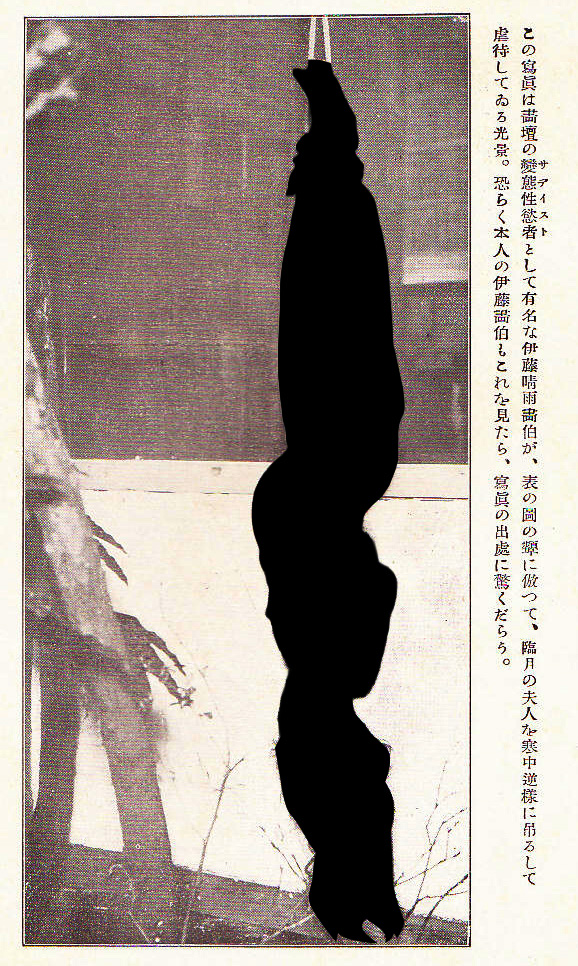
There is a photograph. It is one of the most well-known images in the young history of Kinbaku. A woman, heavily pregnant, being suspended with rope upside down, bound. It was taken in 1921. It is cited, reproduced, and treated as a founding document of an entire practice to this day.
The woman in the photograph is named Kise Sahara.
And that is almost everything we know.
It connects to something I’ve been thinking about for a while. About what gets remembered in this practice, and what disappears. I wrote about it from a different angle in Empty Rope.
What the sources say
Kise Sahara was born sometime between 1893 and 1895. The exact date is unknown. She worked as an actress at the Kaiseiza theater in Tokyo and supplemented her income as a day model, earning 80 sen per day. In 1919, she was introduced to Seiu Ito as a model. That same year they became a couple, she became pregnant, and they married.
In the years that followed, she modeled for snow torture photography, for suspensions, for series that Ito published in magazines and private collections. In June 1921, in her ninth month of pregnancy, she was suspended upside down and photographed. The image is titled Rinketsu Bijin Sakasa Tsuri no Shashin:
“Photograph of a Wife in Inverted Suspension in Her Last Month of Pregnancy.”
In 1925, she joined a theater troupe and traveled with them to Hokkaido. Ito and she divorced. The Japanese SMpedia source notes this dryly in a footnote: “Later, he cheats on her and leaves her.”
In 1926 – one year after the divorce – the pregnancy suspension photograph appeared without Ito’s permission in the December issue of the magazine Hentai Shiryou. The photograph was published alongside a ukiyo-e print by Tsukioka Yoshitoshi, which Ito had cited as the visual inspiration for his work with Kise Sahara.
After that: nothing. No date of death. No further entry.
Not a single word of her own.
The only source that gives her a page of her own – Nawapedia – relies as its primary source on Seiu Ito’s own article “Various Types of Suspension Torment” (Fuzoku Soshi, January 1954). [Nawapedia: Kise Sahara, source note] We know who Kise Sahara was because her ex-husband wrote about her in an SM magazine thirty years later.
The question of willingness
Wikipedia describes Kise Sahara as having “posed willingly for her husband.” Another source says she “voluntarily posed for Ito.” The framing recurs across descriptions of their collaboration. Consent rendered as settled fact, stated without a source.
The word carries a great deal. It closes a question before it can be asked.
What does willingness mean for a woman who earned 80 sen a day as a day model. In a society in which women had almost no economic independence? What does it mean for a woman who was pregnant by her husband, in a marriage in a higly patriarchal society? What does willingness mean when the alternative – refusal, resistance, her own terms – is not documented, because nobody thought to ask?
I am not raising these questions to claim that Kise Sahara was coerced. I don’t know that. Nobody knows.
No source contains her own account. That is precisely the problem. And it is not only a question about 1921. In the last fifteen years, the international shibari scene has engaged in various serious debates about abuse of power, consent, and the asymmetries between riggers and their tying partners. The account of the person being tied is invoked, in these debates, as central. Non-negotiable. In practice, the record looks different: when someone comes forward, they are often not believed, or ignored, or when the case becomes too visible to dismiss, the rigger takes a two-year pause and returns as though nothing happened. The structure remains intact.
And yet the earliest document of this practice that continues to be reproduced today is one in which we do not have the account of the person being tied. We never asked.
The child
Kise Sahara was photographed in her ninth month of pregnancy. She was heavily pregnant. The child is not mentioned in a single available source. No source says whether the child was born alive. Whether it survived or who raised it. Kise Sahara, who separated from Ito in 1925, or Ito himself, who is recorded in the SMpedia source as the father of at least two children from his first marriage.
According to the Japanese SMpedia source, Ito’s children from his first marriage are recorded by name: a son, Masaaki, and a daughter, Kiku. The child or children from his marriage to Kise Sahara: no name, no mention, no date. A child who, like its mother, does not appear in the record.
Whose story?
The 1921 photograph was published without Kise Sahara’s consent – and without Seiu Ito’s consent. For Ito, the photograph became part of his public identity as an artist and “father of modern kinbaku.” For Kise Sahara, it was an image of her pregnant body that entered public circulation without her knowledge, at a point when she was no longer even his wife.
The sources agree: the image was attributed to Seiu Ito, and he was subsequently labeled hentai. A pervert. Whether and how that label fell on Kise Sahara herself – whose body the image showed – is not documented in any source. The question appears never to have been asked.
Everything we know about Kise Sahara comes from sources written about her, not by her. Her perspective on working with Ito, on the suspensions, on the publication of the photograph, on the divorce: not documented. No letter, no interview, no diary entry. Not even a date of death.
The most well-known image in the early history of kinbaku shows her body, and her name does not appear in any of the established historical maps of shibari’s development and lineages.
Who gets to be remembered
This is a question about structures. About how knowledge is produced, who produces it, and whose experiences are deemed historically relevant. Seiu Ito wrote about his own work. He wrote about his models. He wrote about Kise Sahara. As material, as muse, as part of his artistic development. Those texts were archived, cited, transferred into wikis.
Kise Sahara did not write. Or if she did, no one kept those texts.
The result is a historiography in which one person becomes subject and another becomes object. One person has a biography. The other has a chronology of photo sessions. Logically I can not give any answers. But it ventures to ask questions I have not found asked anywhere else.
Sources
All factual claims in this essay are drawn from the sources listed below.
- Nawapedia: Kise Sahara
- Nawapedia: Seiu Ito
- SMpedia: Seiu Ito
- Wikipedia: Seiu Ito
- Kinbaku Today: “Kise Sahara: The First SM Model in Japan?”
- Pen Magazine Online
Japanese-language primary literature (biographies, magazine articles, newspaper coverage from the 1920s) was not directly accessible to me. All Japanese-language sources were read through machine translation.
Discover more from Renée de Sans
Subscribe to get the latest posts sent to your email.