
Conversaciones Silenciosas
When Bogotá Shibari Week first reached out, they asked me what the festival theme could be. If it were inspired by my work. I made a suggestion. They came back with Conversaciones Silenciosas. Silent Conversations.
It was better than what I had proposed. It named something I’d been circling for a long time.
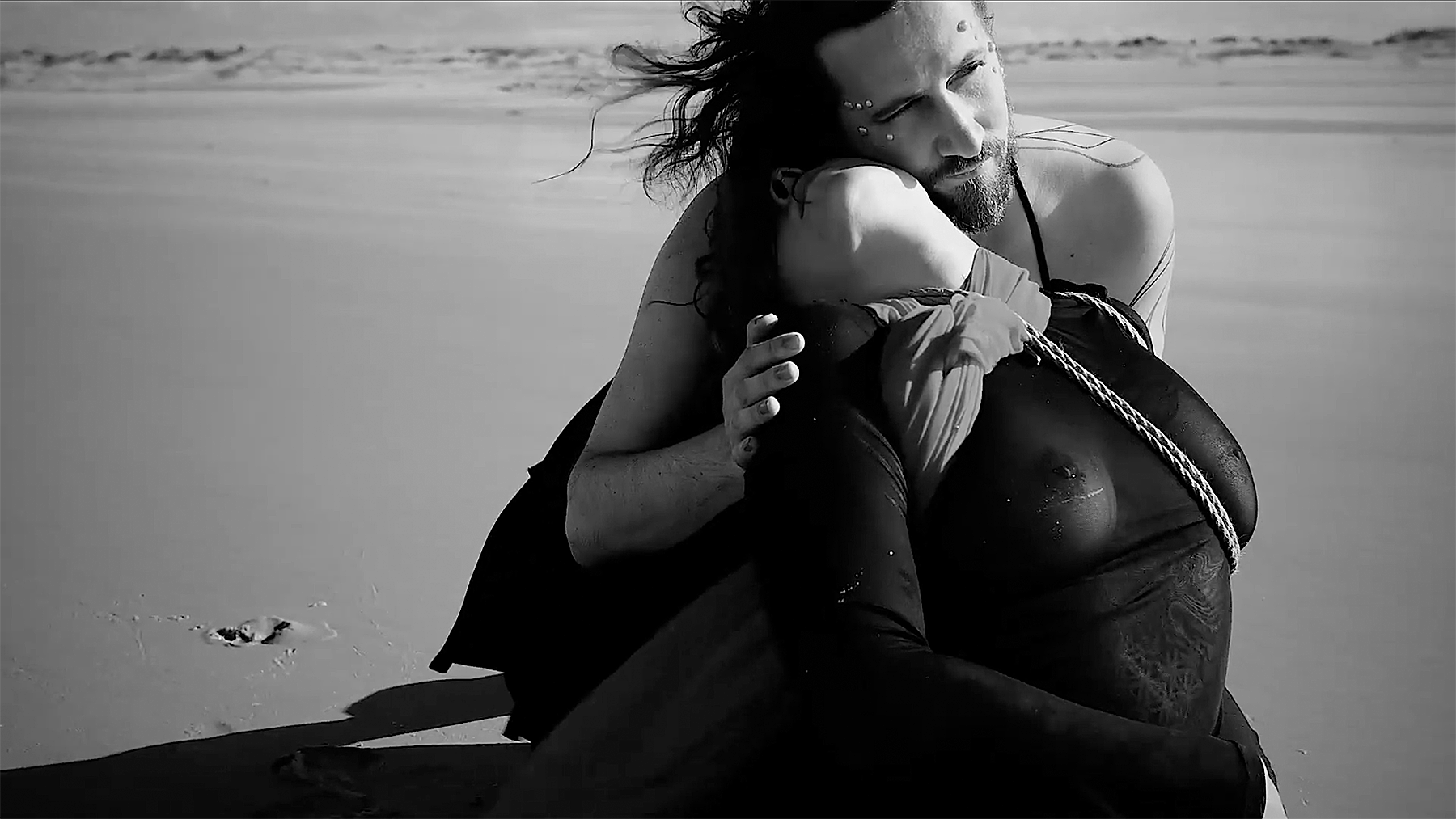
What do bodies say when words lose their meaning? What conversations happen between tension and release, between tying and being tied? I’ve been asking this for years. In rope, in photography, in film. And now a whole week in Bogotá runs under that exact question.
That made me thoughtful, and got me looking at my own work with different eyes. What am I actually doing here? What do I want to say? What conversations am I trying to have?
And then the other direction: what happens when I bring these questions to Bogotá? To Colombia. To a community I’m still getting to know and curious about. It goes both ways — what I bring, and what I take back. What I learn. Where this practice leads me next.

Where I’ll Be
Varieté: Between Pink & Blue · May 18
A performance collaboration with Azul Ropes on opening night. The title says something about where bodies are allowed to exist — between the colors we’re assigned, in the space that’s supposedly empty.
Opening Conversatorio · May 18
¿Cuerpos que conversan sin palabras? — A panel discussion to open the week.
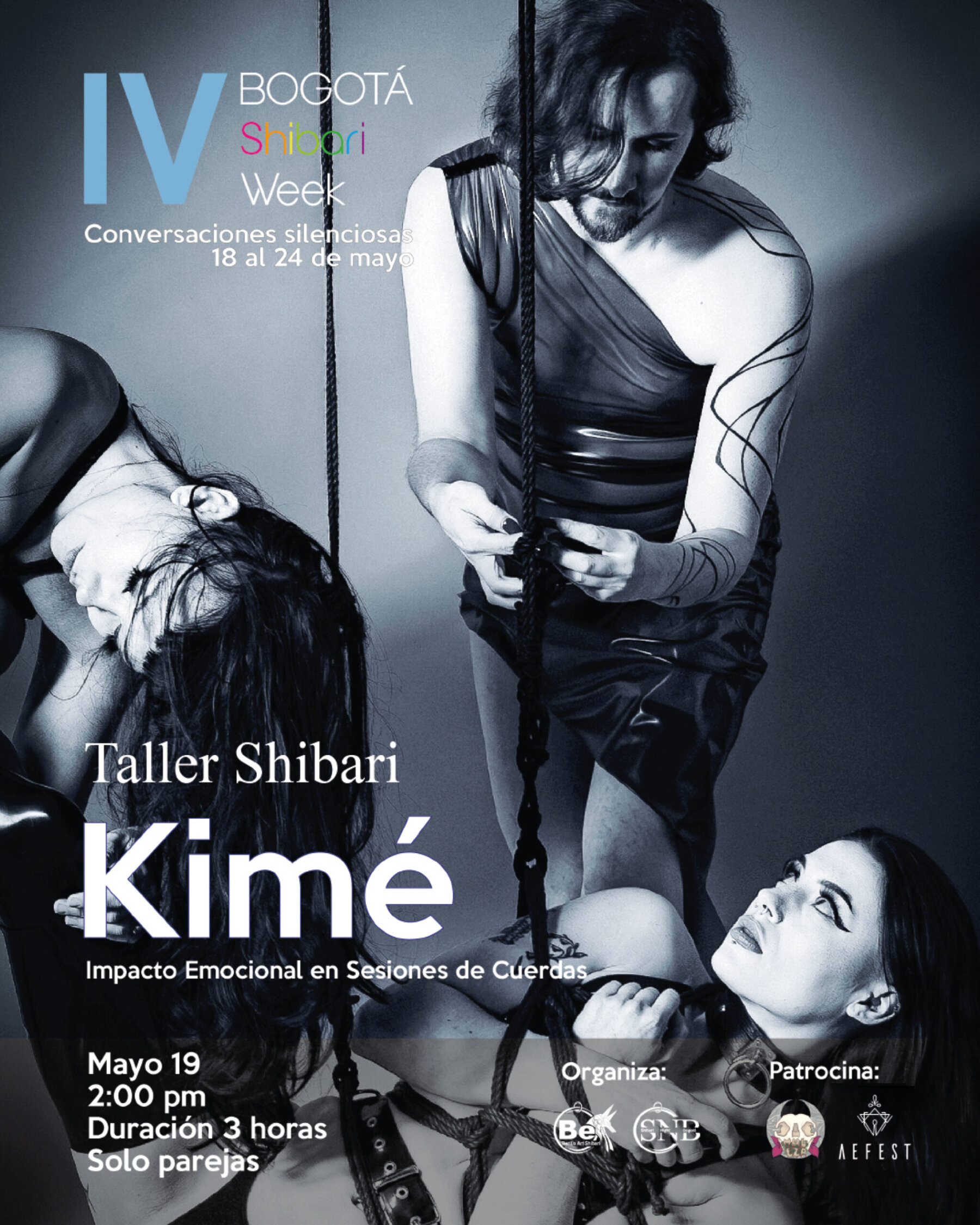
Workshop: Kimé · May 19
Emotional impact in rope sessions. Moments of peak intensity in a session: not necessarily the most extreme physical moment, but the one where something shifts. How do we recognize it? How do we hold it? How do we come back from it?
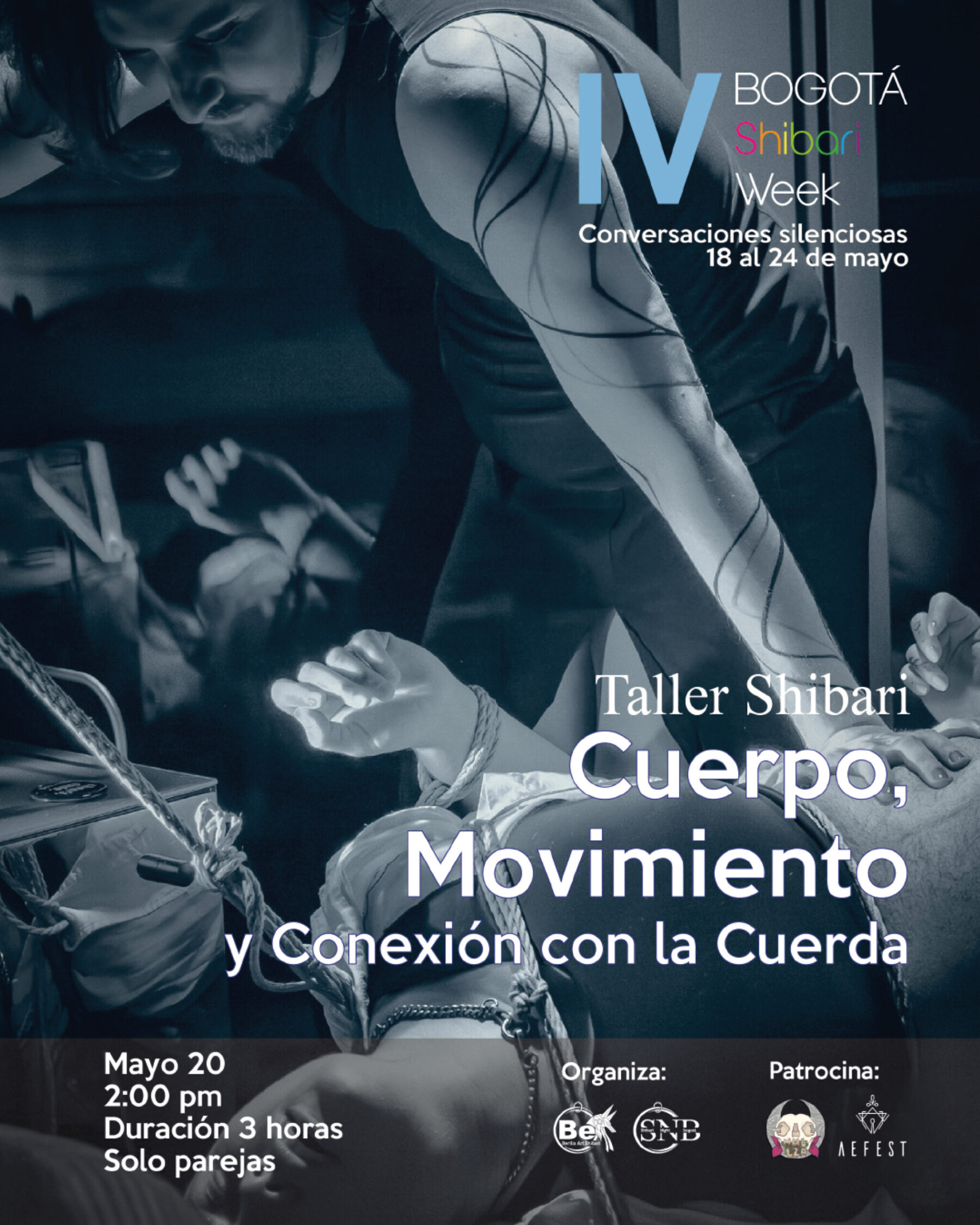
Workshop: Body, Movement & Rope Connection · May 20
Rope as a sensory and relational system. What does it mean to let the rope moves with a body rather than simply constrain it?
Workshop: Edge & Play · May 20
Erotic exploration through rope — for couples.
Workshop: Solo-Flow · May 21
Atad@ a mí mism@. Tied to oneself. For participants who come alone — a space for practicing rope as a relationship with your own body, without a partner as intermediary.
Shibari for Photography · May 21
Both sides of the rope. Both sides of the lens.
Rope Triptych — Collaborative Art · May 22
Three perspectives, one visual structure. A collaborative art session that takes rope out of the session context and into something explicitly compositional. Artistically inspired by the cover art work of ’Ritual de lo Habitual‘ from Jane’s Addiction.


In Between: A Body in Process

In January 2026, I posted my transition timeline on Reddit. Before and after pictures. On the left: me six months before starting hormone replacement therapy (HRT). On the right: me twenty-one months in. Red dress in both photos. Growing into myself. Visible joy and confidence.
The post was removed within hours. Not for hate speech. Not for breaking community rules. But because some trans people reported it as “fake” or “trolling.”
The reason? I have a beard. My timeline — my body, my journey — was flagged as not trans enough.
I reposted with a longer explanation. This time the post stayed up, and the comments section became something I didn’t expect: a battleground, a celebration, a therapy session, and a mirror all at once.
Some people wrote:
“This is the most relatable progress pic I’ve ever seen.”
“Oh hell yeah, that’s gender as fuck.”
“Your visibility is helping me feel better about myself.”
Others said:
“Why beard?! Honestly, you should shave.”
“Nothing against you.
It just gives other trans women a bad look.”“People like you are why transphobia exists.”
Both reactions came from trans people. From within the peer group I thought I belonged to. That second set of comments — the ones that framed my existence as a liability — is where this journal starts. Because the question they were really asking wasn’t Is she trans? It was Is she acceptable? And that’s a much older question than Reddit.
The Beard as Fact, Not Statement
Let me be clear, because it matters for everything that follows: I don’t have a beard because I want one. I’m not making an aesthetic choice or staging a gender-fuck gesture. I have a beard because I’m not yet at the point in my process where I’m ready to let it go. That’s the uncomfortable truth. And it’s more complicated than either “just shave” or “beards are valid” allows for.

My dysphoria is not linear. Removing the beard right now — whether through daily shaving, laser, or electrolysis — would trigger other dysphoria I’m not equipped to handle yet. My face is changing on HRT. My relationship to my body is shifting. And at this stage, the beard is what allows me to keep moving forward. This has nothing to do with ideology. Everything to do with survival.
It also has to do with money. Laser hair removal costs €3,000–5,000. Electrolysis costs more and takes years. Right now, that’s not where I am.
But here’s where the beard stops being the real story: Even as I say “I’m not ready yet”, I also need to ask — what if I never am? What if, even when I could afford it, even when my dysphoria shifts, I still don’t remove it? What if some trans women just … have beards?
Cis women with PCOS grow facial hair. Cis women going through menopause do too. Womanhood has never been a monolith, even if Western beauty standards pretend it is. So why do trans women have to meet a standard that isn’t even valid for cis women to begin with?
Because patriarchy polices all women’s bodies — and trans women are punished twice: once for femininity, once for transition.

Passing as Currency
I understand why passing matters. For many trans people, it’s not about aesthetics or validation — it’s about survival. About moving through the world without being clocked. About jobs, housing, staying alive. I have the privilege of living in Berlin, where visible queerness is less likely to get me killed than in many other places. I work in art and community spaces where my transness is sometimes even celebrated. I know this.
But for some, passing has become more than a survival strategy. It has become a currency. A way to measure who’s “doing it right.” A way to decide who belongs. Passing is also an administrative ideal. Medical systems want linear narratives — HRT, hair removal, surgery, name change, done. Legal systems want bodies that are legible and sortable. The state benefits when transness can be managed and made invisible.
Someone wrote: “If we don’t conform to the way THEY want us to look, then there is a problem.”
Embedded in that sentence is the assumption that transition has one acceptable outcome: to become indistinguishable from cis people. To disappear into the binary. I started HRT because I wanted to feel aligned with my own body — softer skin, shifting contours, a picture of myself that might feel more like home. Because I do not identify as a man. That was never about erasing myself. It was about becoming myself.
And yet, that still reads as doing it wrong.
Respectability Politics
“People like you are why transphobia exists.”
This is the comment that stays with me. Not because it’s cruel — but because it’s honest. The logic is clear: If we don’t conform, if we don’t pass, if we keep visible markers of our assigned sex, then we are responsible for the backlash. This is respectability politics. And it doesn’t save us.

Respectability politics promises that if we behave well enough, look right enough, pass convincingly enough, we might earn acceptance. History says otherwise. Black Americans were told respectability would protect them. It didn’t. Queer people were told being ‘well-behaved’ would earn acceptance. It didn’t. Again and again, marginalized groups have learned the same lesson: compliance does not stop violence, dignity does not guarantee safety, and silence does not buy protection. Even when we do everything asked of us, we are still punished for existing.
Trans people are being offered the same bargain now: be quiet, be grateful, don’t make us uncomfortable. Underneath it all, the same rule: make yourself small enough to be ignored.
Delegated Violence
Respectability politics isn’t just about aesthetics. It’s about access. “Just get laser” assumes generational wealth. “Just shave every day” assumes time, skin resilience, manageable dysphoria. “You should have done this already” assumes one universal timeline. These assumptions erase the material cost of transition — financial, physical, emotional.
But there’s another layer. The enforcement doesn’t only come from fear. Structurally, it often comes from those who already pass. Who already have access — to money, care, relative safety. Whose own story only holds if the path they took was the correct one. When passing becomes the entry ticket, deviation becomes a threat — not to safety, but to legitimacy.
This is delegated violence. The work the state and medical systems would otherwise do — you don’t belong — is outsourced to the community itself. Reframed as concern. As protection.
Authenticity vs. Survival
I want people to exist authentically. To keep beards, deep voices, broad shoulders — if that’s what feels right. I also know visibility can be dangerous. That passing is sometimes the only shield between someone and violence, homelessness, loss. So when someone says, “You’re making it harder for the rest of us”, I hear the fear underneath. And I don’t know how to resolve that tension cleanly. What I do know is this: the fear doesn’t come from me. It comes from a transphobic world. And we can’t solve that by making ourselves smaller.
If you need to pass to survive — do it. If you need to go stealth — do it. But don’t ask me to disappear so you can feel safer. My visibility isn’t the problem. The system is.
My Body, my Timeline
After the Reddit drama settled, I put on make-up, a black dress and made self-portraits. I documented myself — again — present in my body as it is now.
“Why beard!?” The question isn’t rhetorical.
Because I’m not ready to let it go. Because “just do it” isn’t always an option.
And also: Because not every woman looks the same.
Because the binary was never the destination.
Because “woman” is not a checklist.
Even if I could afford laser tomorrow, even if I were ready — the question of whether I should have to would still be political. My timeline is mine. Yours is yours. Neither of us owes justification. There is no right way to be trans. There is only the way that keeps you alive and as whole as possible. For me, right now, that includes a beard.
Some comments were cruel. Some were affirming. Some were quietly grateful. Not everyone can afford to be visible. Not everyone can afford to be in process publicly. And no one owes visibility to be valid. The responses that mattered most were simple:
“I didn’t know I could start
without having everything figured out.”“Thank you for showing there are different ways.”
This isn’t about a beard. It’s about who gets to be visible — and who gets to decide the rules. Trans liberation isn’t uniformity. It’s coexistence. It refuses not just the man/woman binary, but the pass/fail one. Someone needed to see this. To know that transition doesn’t have to be finished to be valid.
That’s who this is for.
