
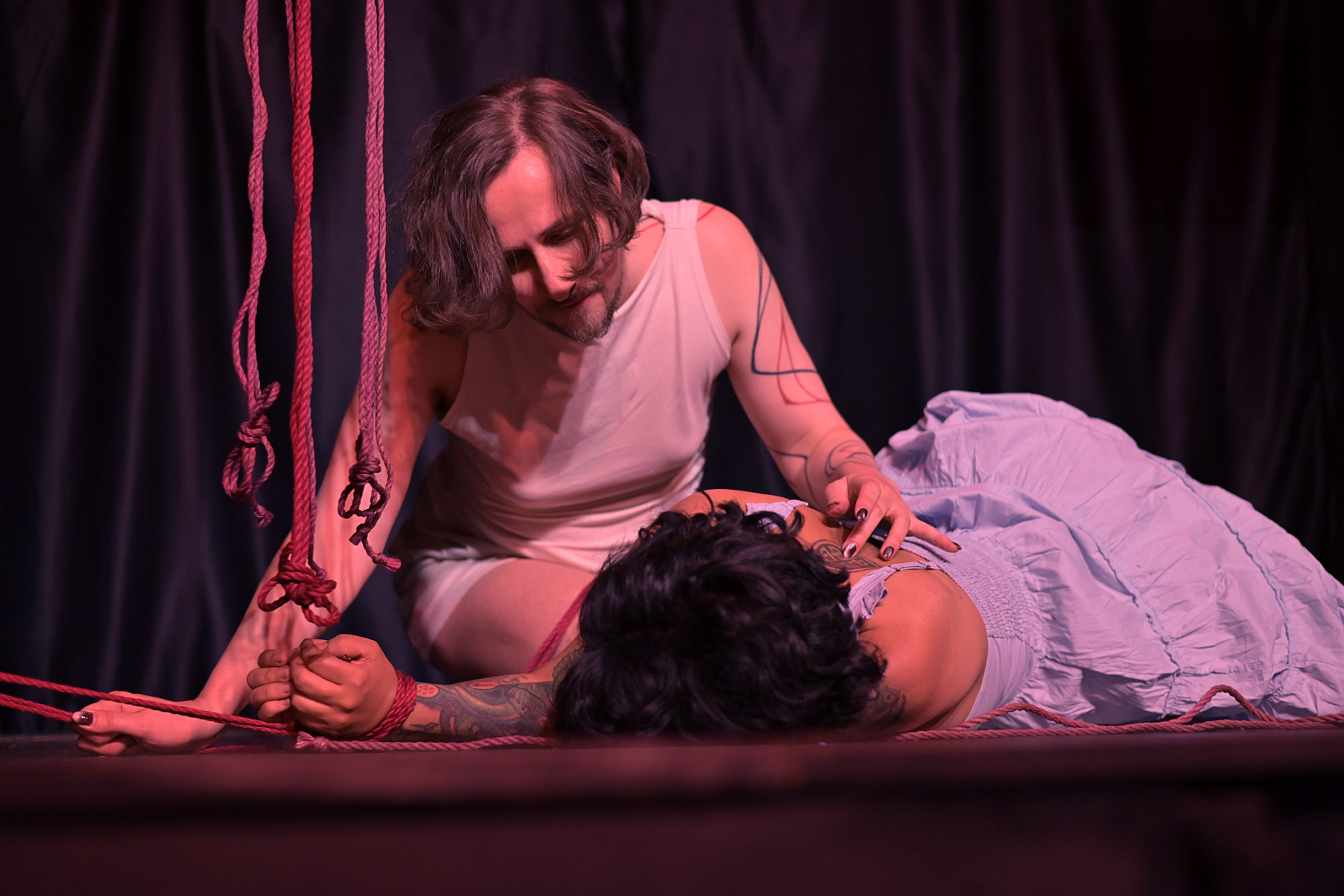
Bogotá: On Touching Hearts
I arrived at El Dorado, the Bogotá Airport at four in the morning. Tired and stressed and wrung out from the flight and the past months. At 1pm it began with a panel talk to introduce the IV Shibari Week Bogotá. Directly after there was the Varieté, a shibari performance night. I was supposed to do the last performance with Liebre Azul, my tying partner from Colombia whom I had never met in person before.
Before our performance we had only half an hour to find out whether we could understand each other. Not in words, but in movement, in rope, in whatever happens between two bodies during a rope performance.
At the end of the fourth Bogotá Shibari Week I was left feeling more affirmed in my rope practice than I have ever felt before. It took me some days and reflections to understand why.
I Arrived With Doubts
After being invited by Shibari Night, I was doubting if I belonged at the front of such a festival. They had invited me as the international special guest, and a quiet voice in my mind kept asking what I could possibly share with these people that they didn’t already know. What I could bring that’s uniquely mine.
The festival’s theme was silent conversations. And the classes I had planned around it were the hardest thing I could imagine teaching. The fine nuances and the invisible layers of tying. The parts you cannot quite grasp technically, the parts steered by feeling more than by form. I had put together classes I had never taught before, on exactly the thing that resists being taught at all. I did not yet know whether any of it would hold up in front of a room — in a cultural context not my own, about a practice that comes from Japan, not from either of us.
Technique and Feeling
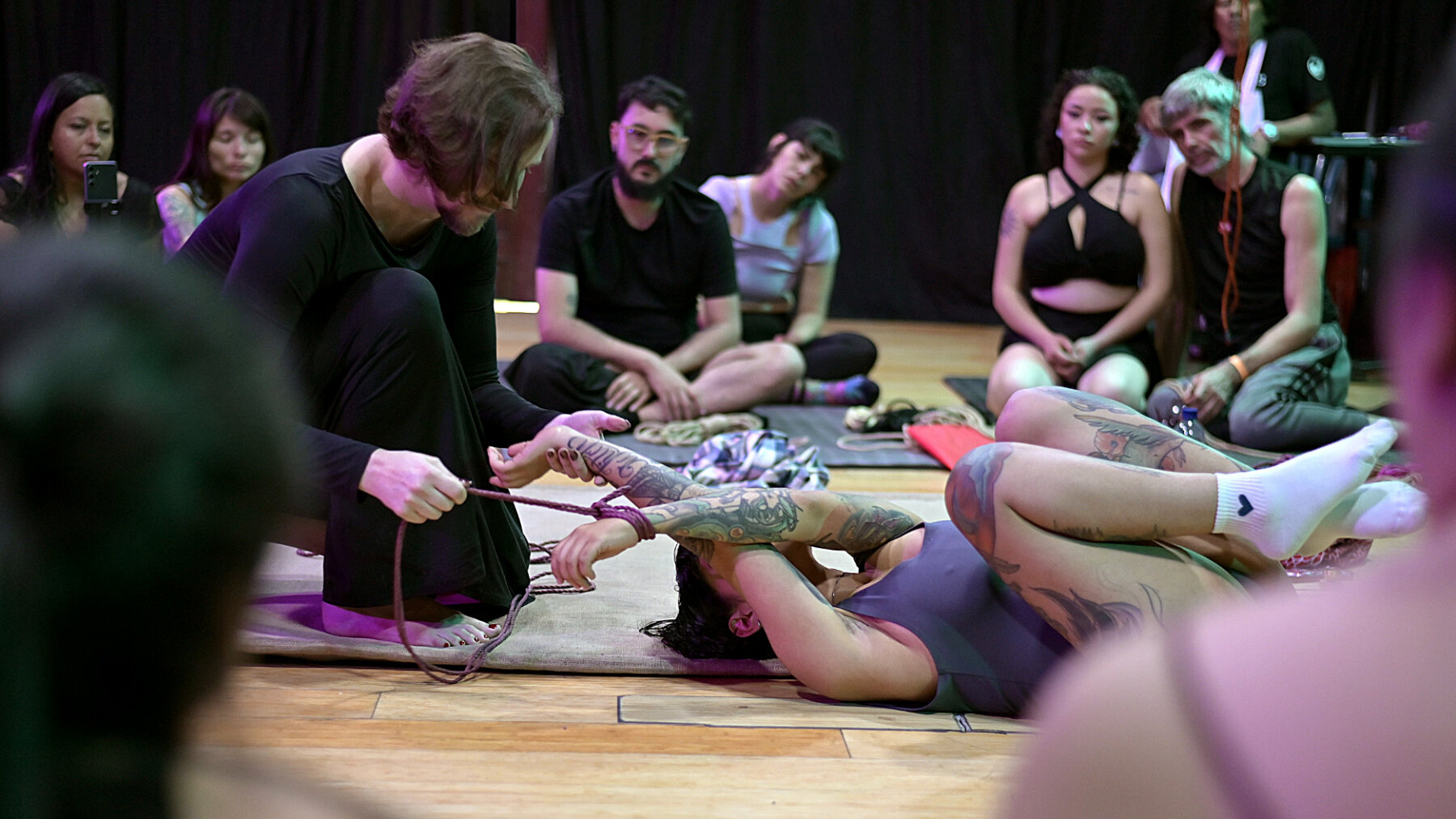
The friction I want to describe is not Colombian, and not European either. It runs through every rope scene I have spent time in. Shibari is an intimate practice that happens (mostly) between two people, and there is a point in many people’s journey where the ego pushes its way into the practice. Where someone wants to prove they are valid, wants to show how good they are, and reaches for technical excellence to do it. Clean lines, correct forms, the purest style, the right vocabulary. And in that reaching, the path of intimacy and often trust gets left behind.
I went to Colombia and recognized my experiences from Europe in some private conversations there. The same two pulls inside the practice. And inside most of us who tie. Almost everyone wants both: the competence and the connection. But people weight them differently, and some lean so far toward technique that rope becomes something to be ranked and earned, while the exchange, the trust, the silent conversation between two bodies slips into the background.
Certificates Don’t Touch Hearts
I do not think the border is drawn out of malice. People pay a lot of money and spend a lot of time to learn this practice, and they want something solid to hold onto. Certification can offer exactly that.
What it quietly assumes is that shibari is a craft whose value lives in correctly executed forms, and that mastery can be ranked, examined, stamped. Learn the patterns, pass the levels, and you are doing it right. Prioritize feeling over form and you are doing something lesser.
I understand the appeal. Technique is teachable and measurable in a way a feeling never is. A solid technique also matters in a practice where so much can go wrong. But I have watched a tool for keeping people physically safe slowly turn into something else: a way of deciding who belongs, the checklist drifting from serving the practice toward policing it.
So my quarrel is not with skill, or with the people who spent years earning it. It is with the moment skill stops being something you learn for the safety of your partner and becomes a badge you have to show at the door.
What gets lost is the part that cannot be certified: presence, the capacity to listen with your hands, the flexibility to get messy, the willingness to not know what comes next.
A Silent Conversation
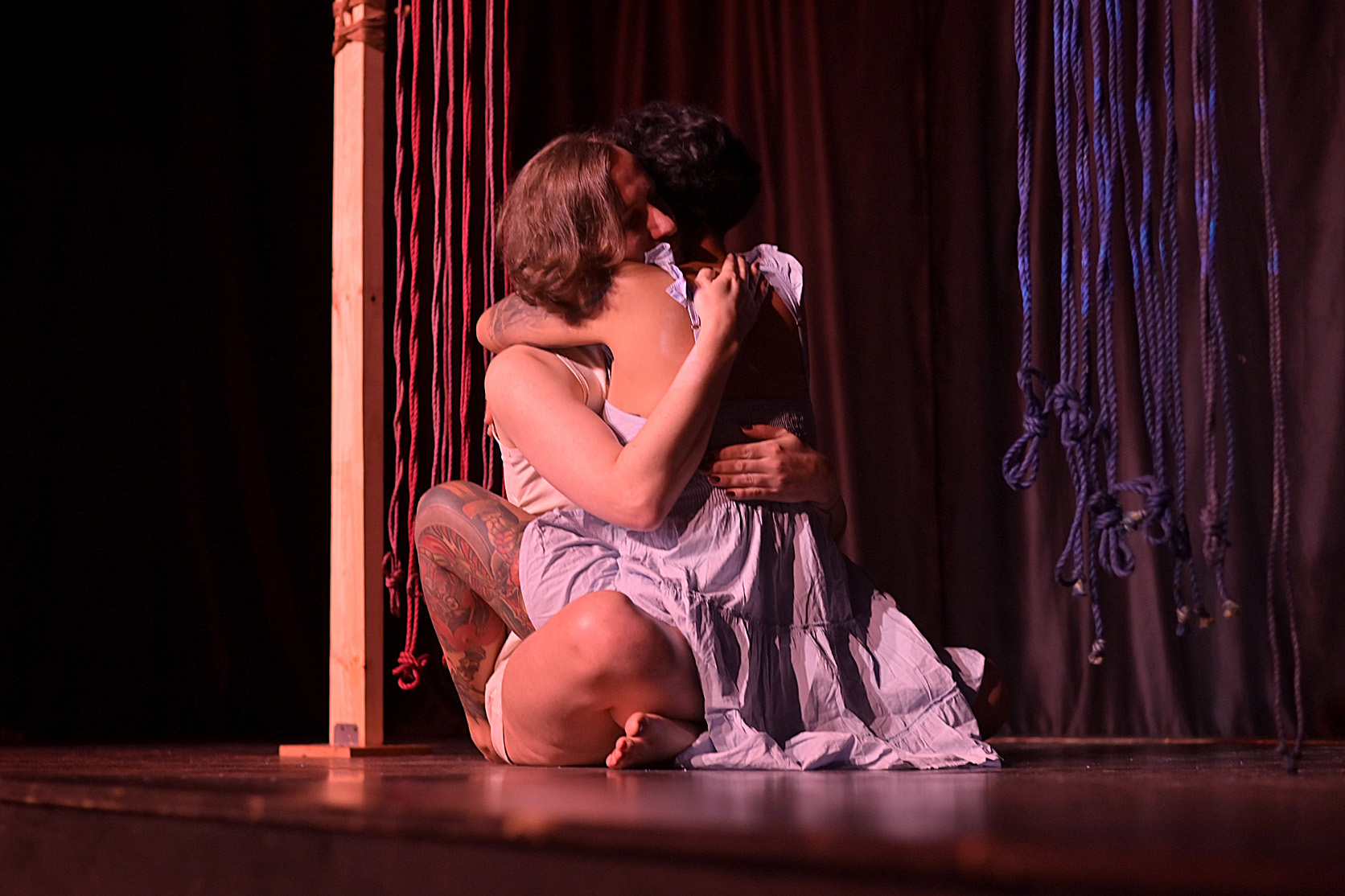
Azul and I had half an hour. We agreed on a rough outline and had only tied a little, to feel whether we could move together. It was enough to feel confident with each other.
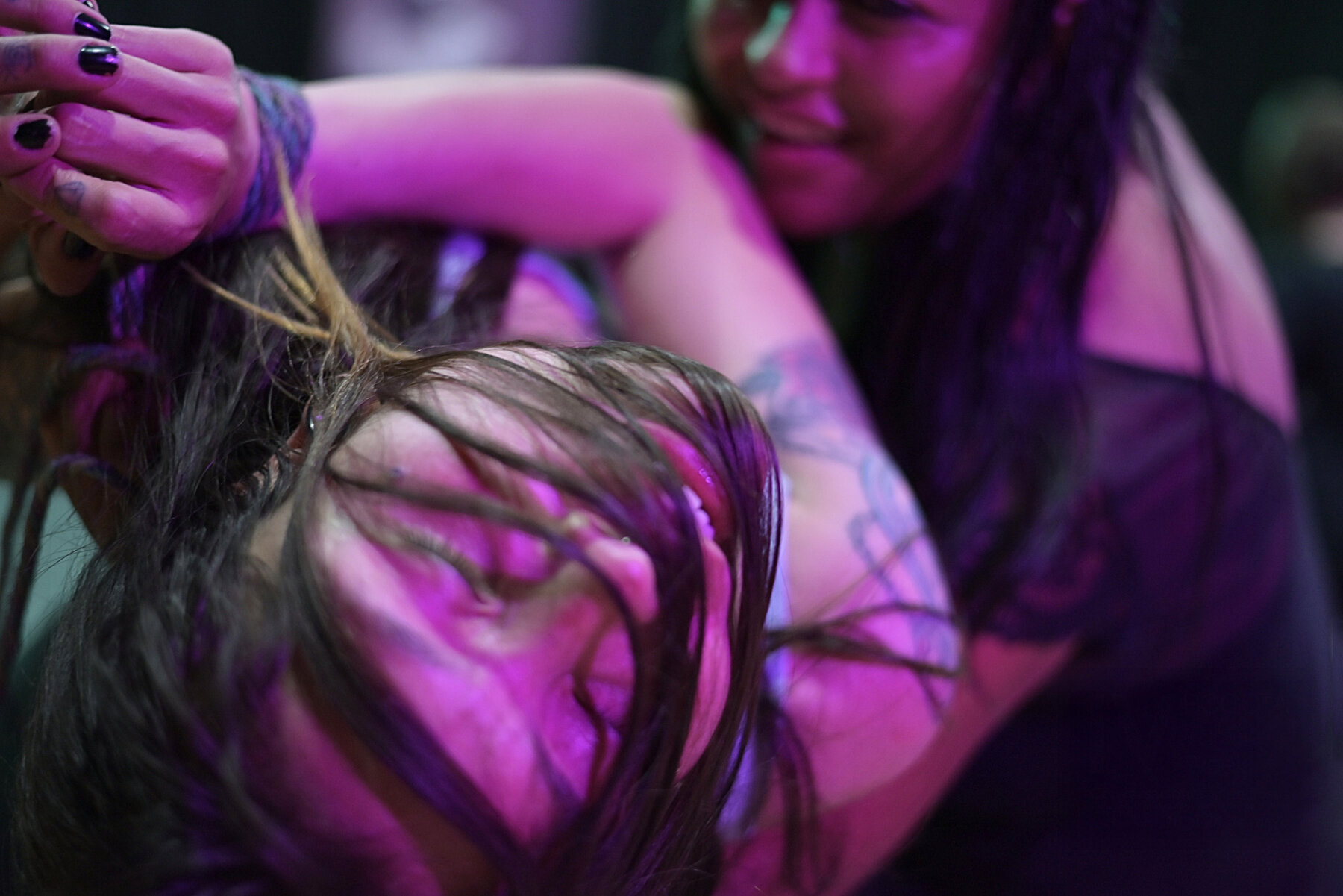
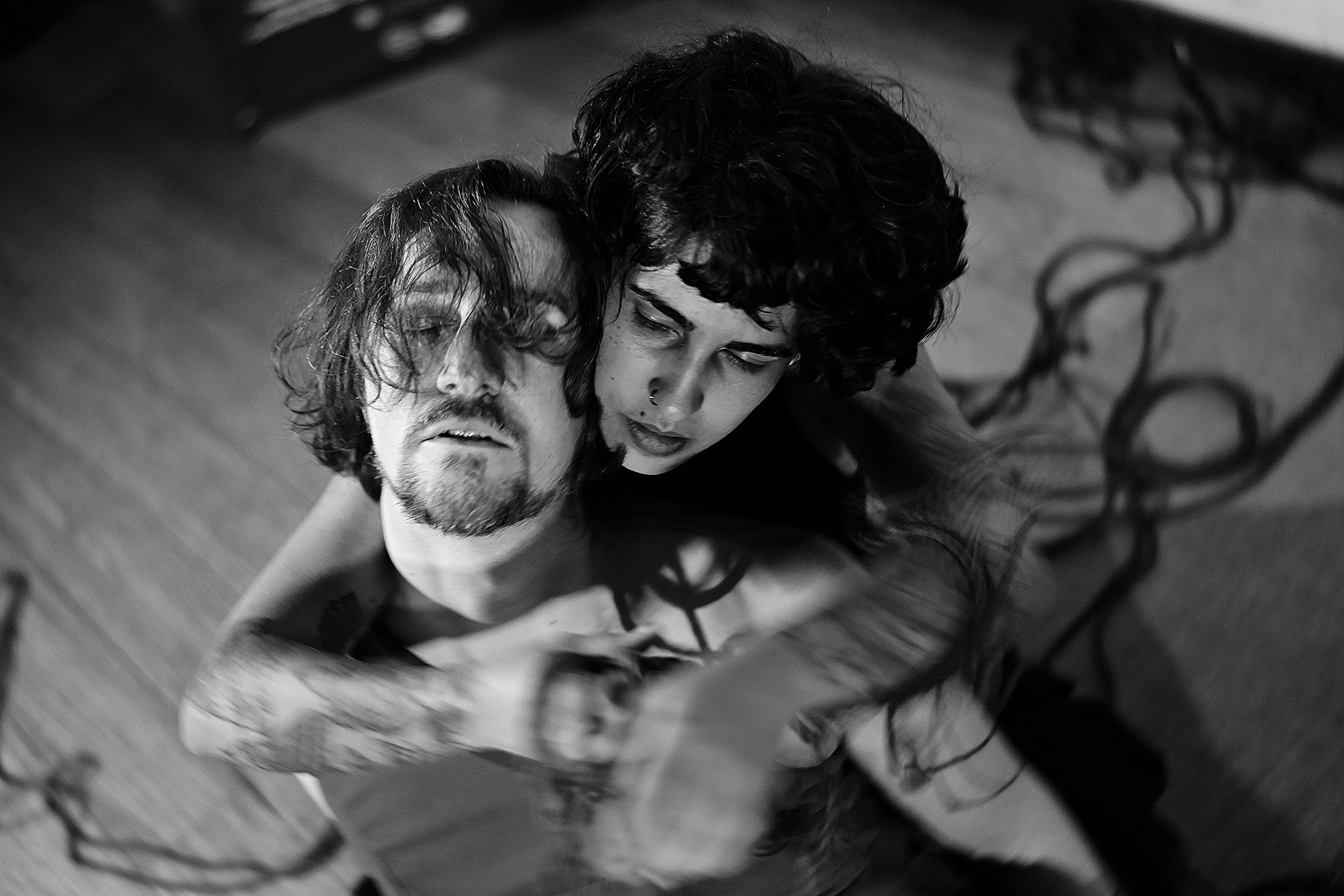
We wanted to open with a statement. Rope performances so often begin the same way. One person seated, the other standing beside them or walking in, the rope present from the first moment. We refused that. Before the curtain opened, we were already on the floor, holding each other in a hug, close like lovers. Calming each other down to get rid of the nervousness.
When the curtain opened, we did not move. We held that position, completely still, for almost three minutes – the length of the short introduction song. As the song ended, we began to move almost in slow motion. It was an intimate moment of exploring each other via movement and touch. Six, maybe seven minutes had passed before we introduced the first rope.
By then the room was already captivated.
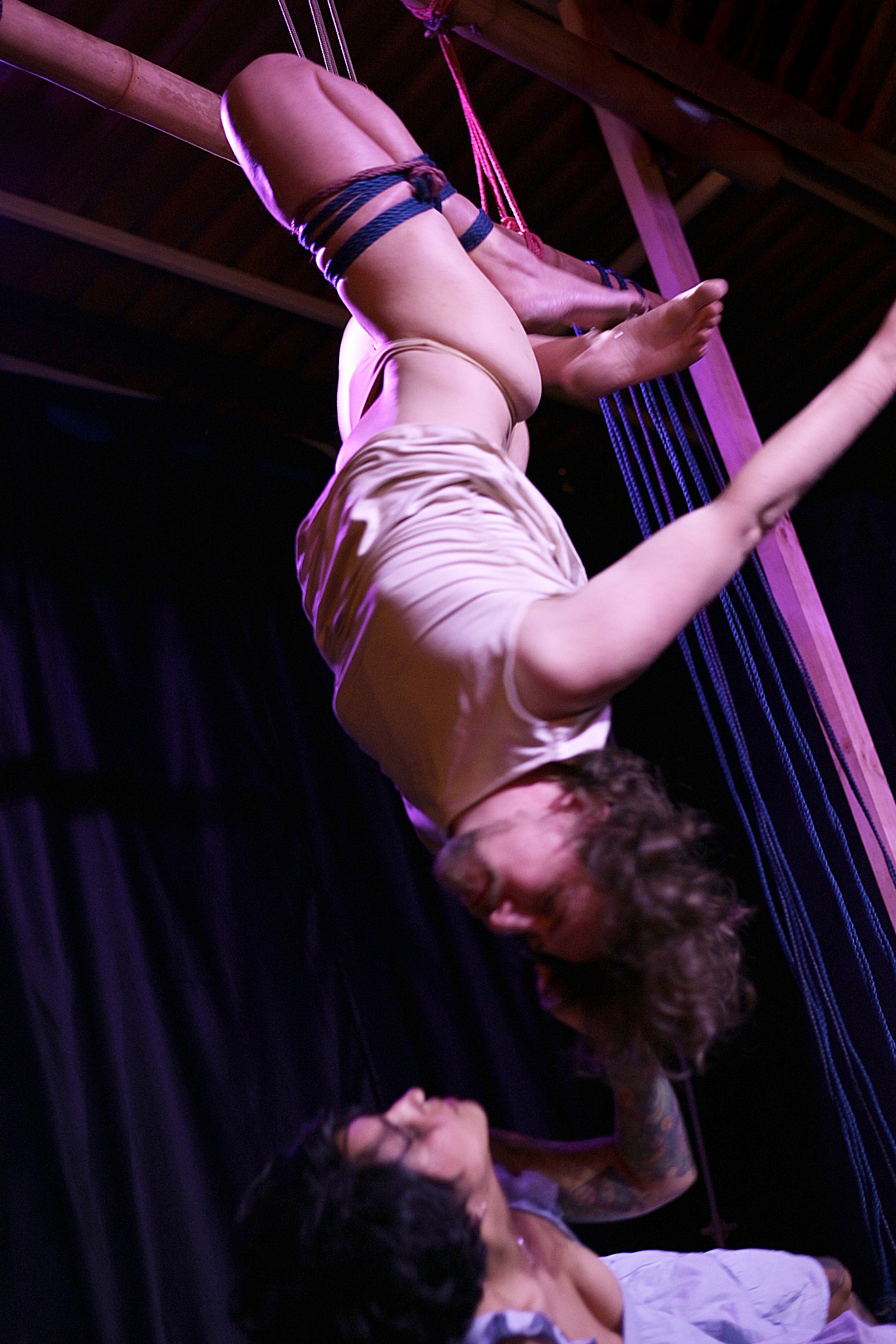
And the performance ended as it had begun: Inverted. Me alone, upside down, hanging from a single futomomo, pulled slowly upward with a pulley system to an instrumental of Space Oddity.
People asked us afterwards how we had managed to rehearse the whole performance in such a short time. We mostly hadn’t. The beginning and the end were planned: the still embrace, the inversion to close. Everything in between had been improvised. No choreography to memorize, no forms to reach for. We simply listened to each other and went with the flow.
A Confirmation From Outside
Through the week I taught four workshops, participated in a photoshoot event, and created a collaborative photo work with the community. People told me that it is rare in Colombia to find rope teachings about the emotional and interpersonal aspects of tying.
In conversations I had the sense of a community that wants exactly this, and that does not always find it easy to claim space for it. I cannot make any claims here, because I only heard it in personal conversations — but the shape felt unmistakable to me. It is the same shape I know from running Karada House.
You build something around the relational side of the practice, and somewhere there is always pressure suggesting that this is not quite the real thing, not quite rigorous enough.
Without intending to, I could offer something that felt to some like a confirmation from outside: the human, relational side is legitimate. You do not have to justify it to anyone. Your heart matters.
The Morning Messages
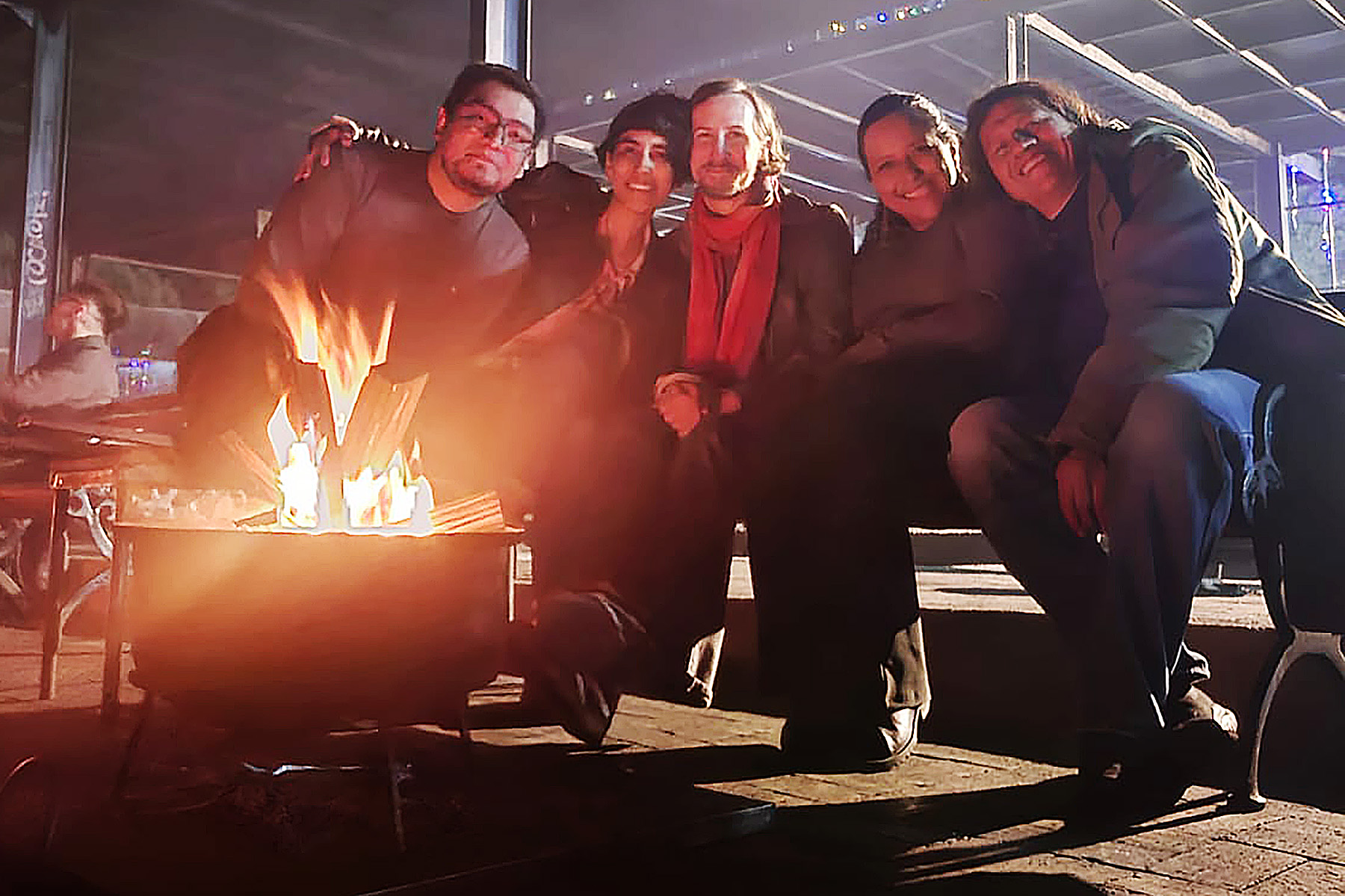
The best way I can describe the warmth of that week is to tell you what happened every morning. I woke up to messages from the organizers. They were mostly not about logistics. These were messages about how the days were going, how their hearts felt. They shared positive feedback from the workshop participants with me. They constantly checked in with me to see how I was doing, asking about my needs. Inquired about my needs. And one message ended simply: “Thank you for giving us part of you.”
That kind of care was far from what I had expected.
I watched the community the same way. The constant checking-in, the way people looked after each other. It was easeful in a way that surprised me, leaving my queer Karada House bubble. Seeing this filled me with some hope.
And on the last day, a fellow queer person came to me in tears, to tell me what those days had given them. By the end, a whole group sat together crying, touched by each other. Very beautiful.
The Open Heart
People are reached when you open your heart, not when you win the argument about what real shibari is. When you share your own way, from passion, instead of reaching for a standard to enforce. Sharing what is yours, giving others space to make it their own, and to disregard what doesn’t make sense to them.
I came to Bogotá with doubts. I left with answers to questions I had not asked. It showed me that you find a place in people’s hearts when you show up with what moves you, and when you leave your ego behind. Open to listen, instead of pretending to have the answers for everything. When I left, I felt that a part of my heart stayed there.
Muchas gracias, Bogotá, sumercé.
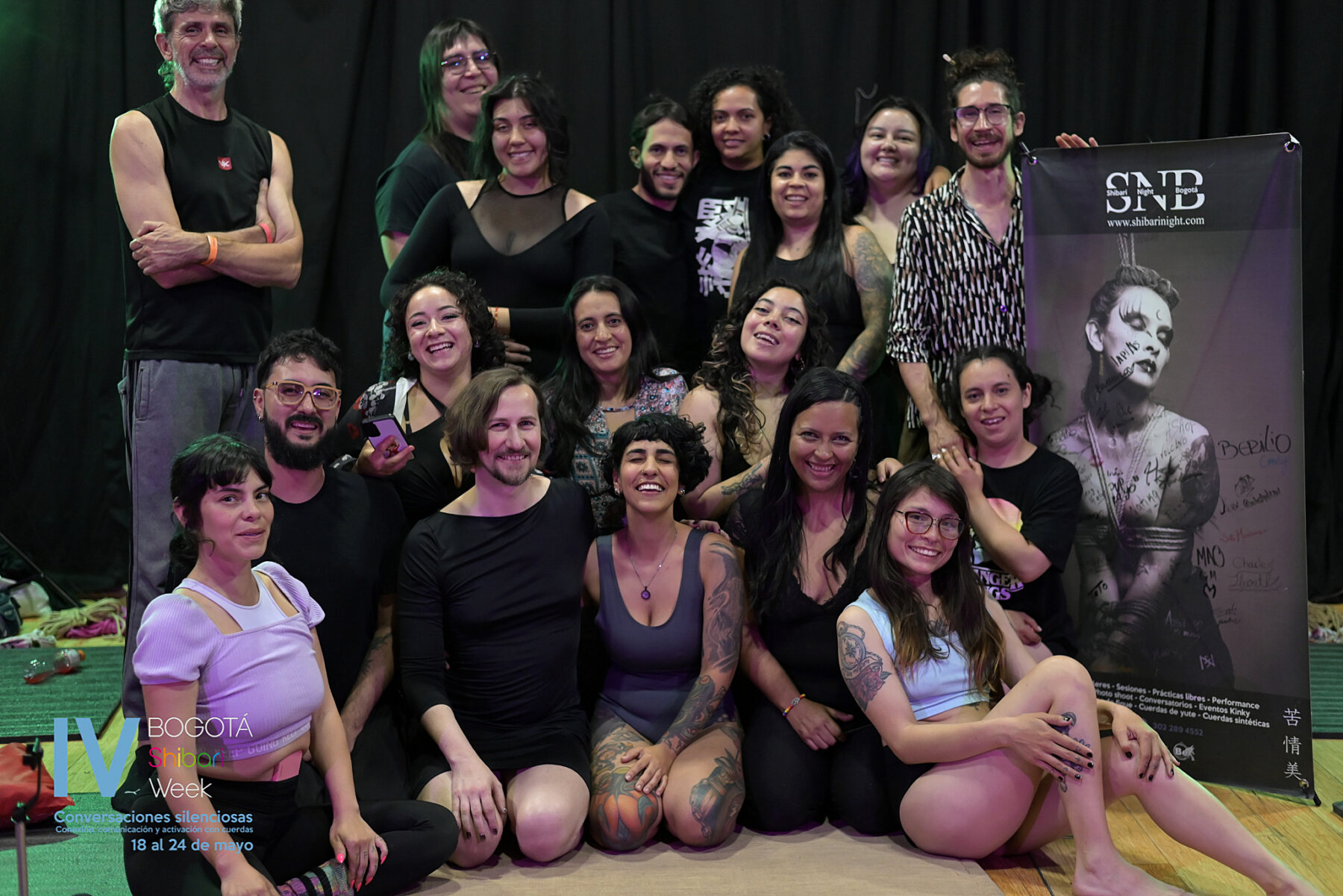
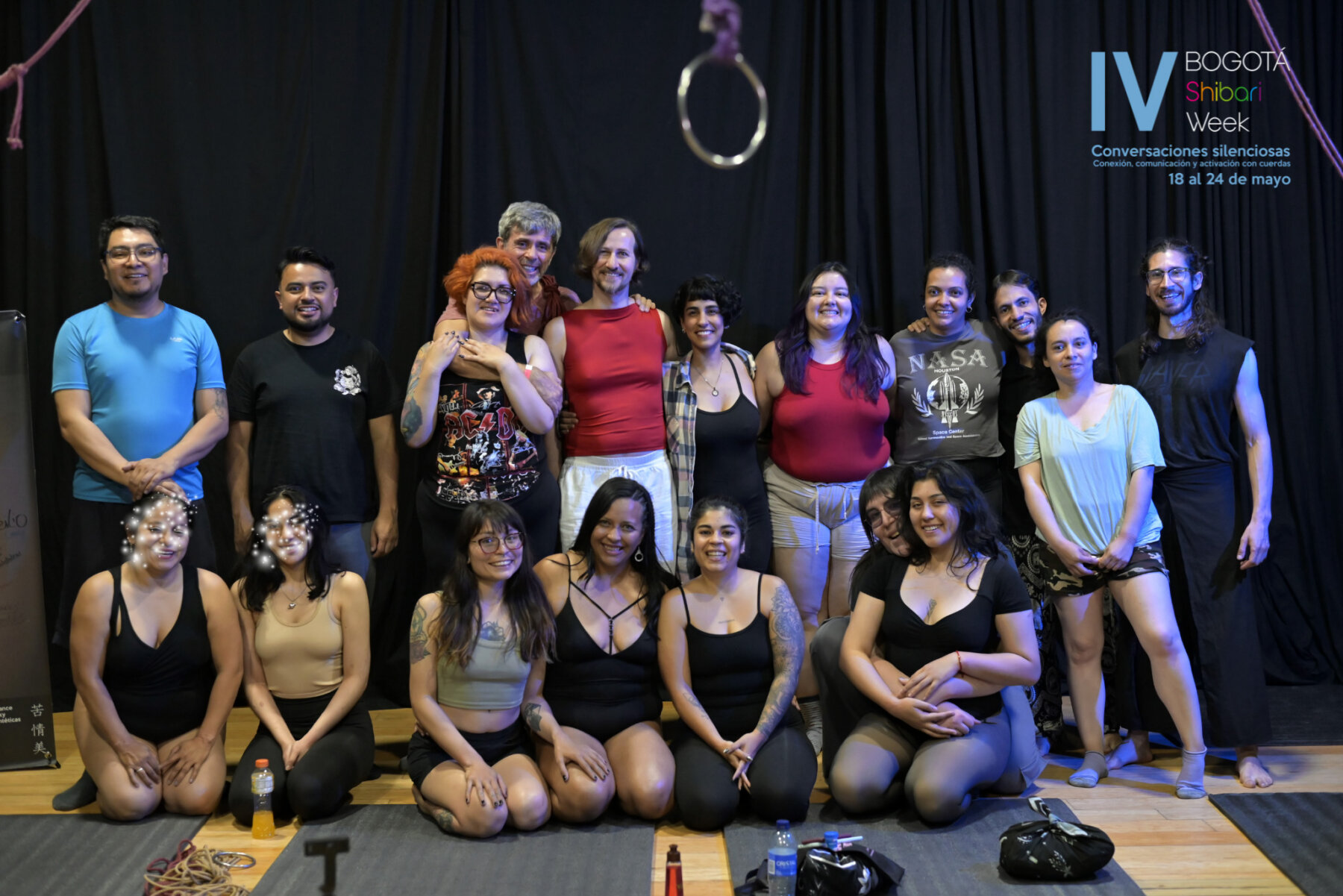
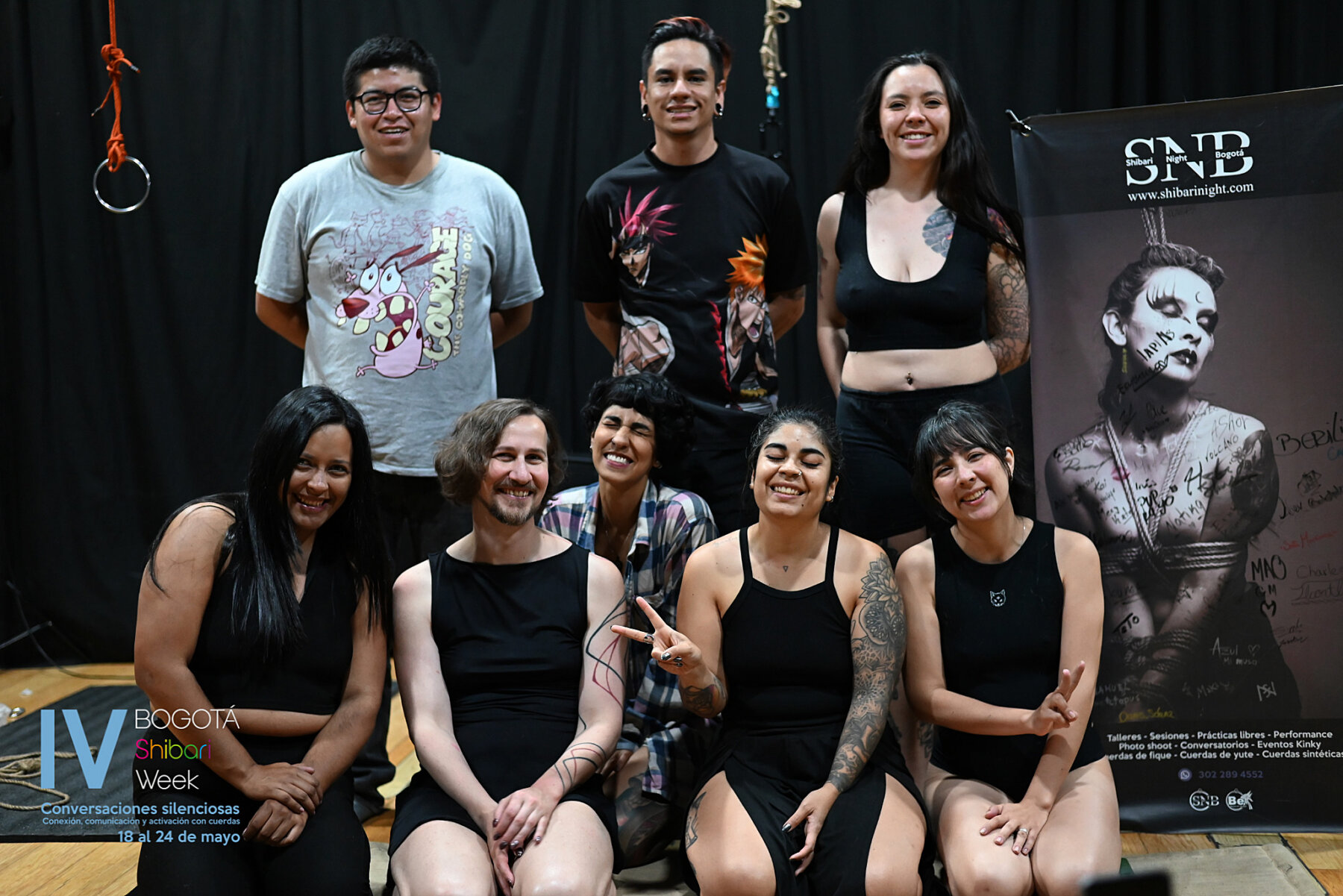
Photo Credits: Charles Ilcoatl & Shibari Night

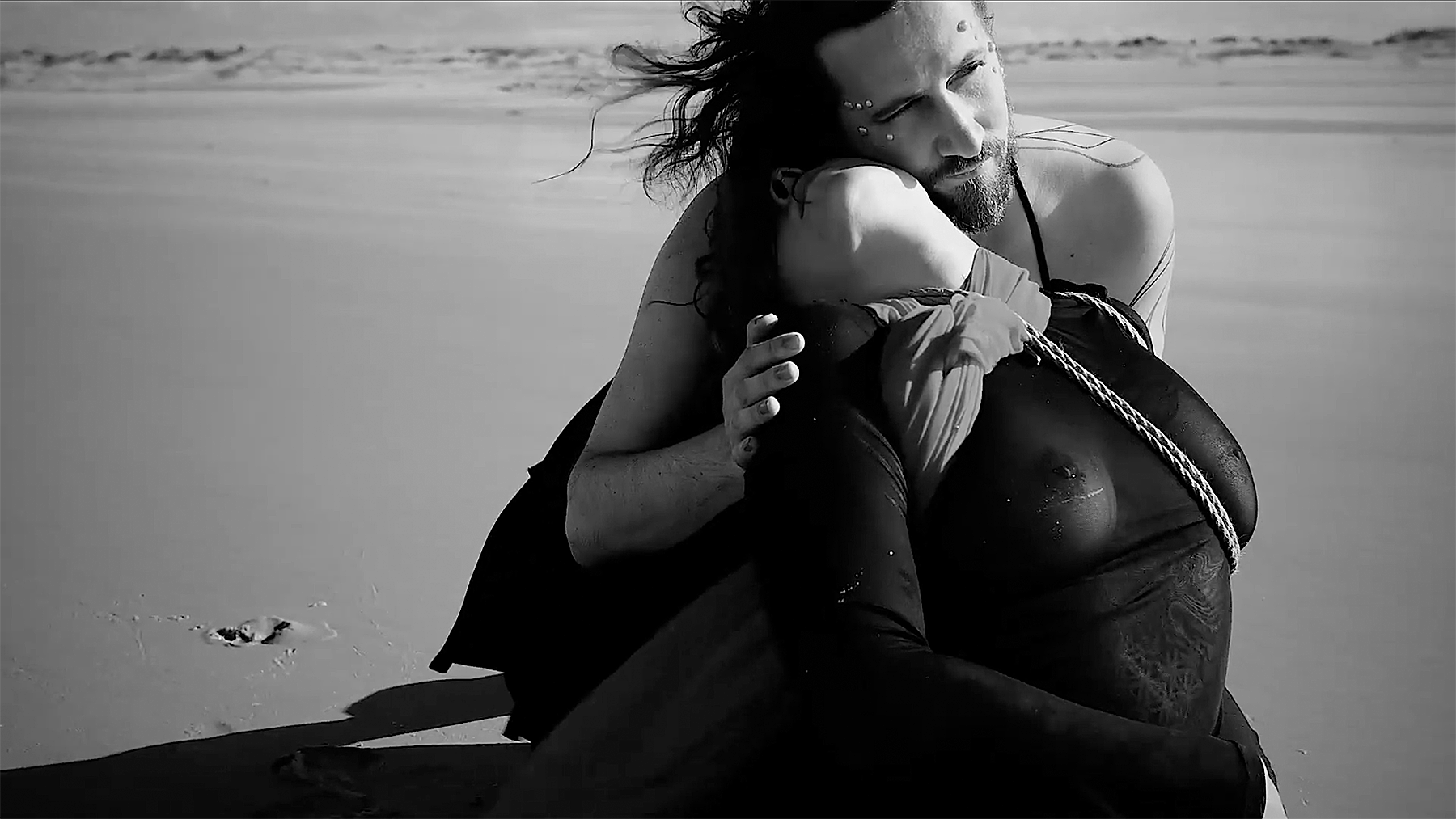
Conversaciones Silenciosas
When Bogotá Shibari Week first reached out, they asked me what the festival theme could be. If it were inspired by my work. I made a suggestion. They came back with Conversaciones Silenciosas. Silent Conversations.
It was better than what I had proposed. It named something I’d been circling for a long time.
What do bodies say when words lose their meaning? What conversations happen between tension and release, between tying and being tied? I’ve been asking this for years. In rope, in photography, in film. And now a whole week in Bogotá runs under that exact question.
That made me thoughtful, and got me looking at my own work with different eyes. What am I actually doing here? What do I want to say? What conversations am I trying to have?
And then the other direction: what happens when I bring these questions to Bogotá? To Colombia. To a community I’m still getting to know and curious about. It goes both ways — what I bring, and what I take back. What I learn. Where this practice leads me next.
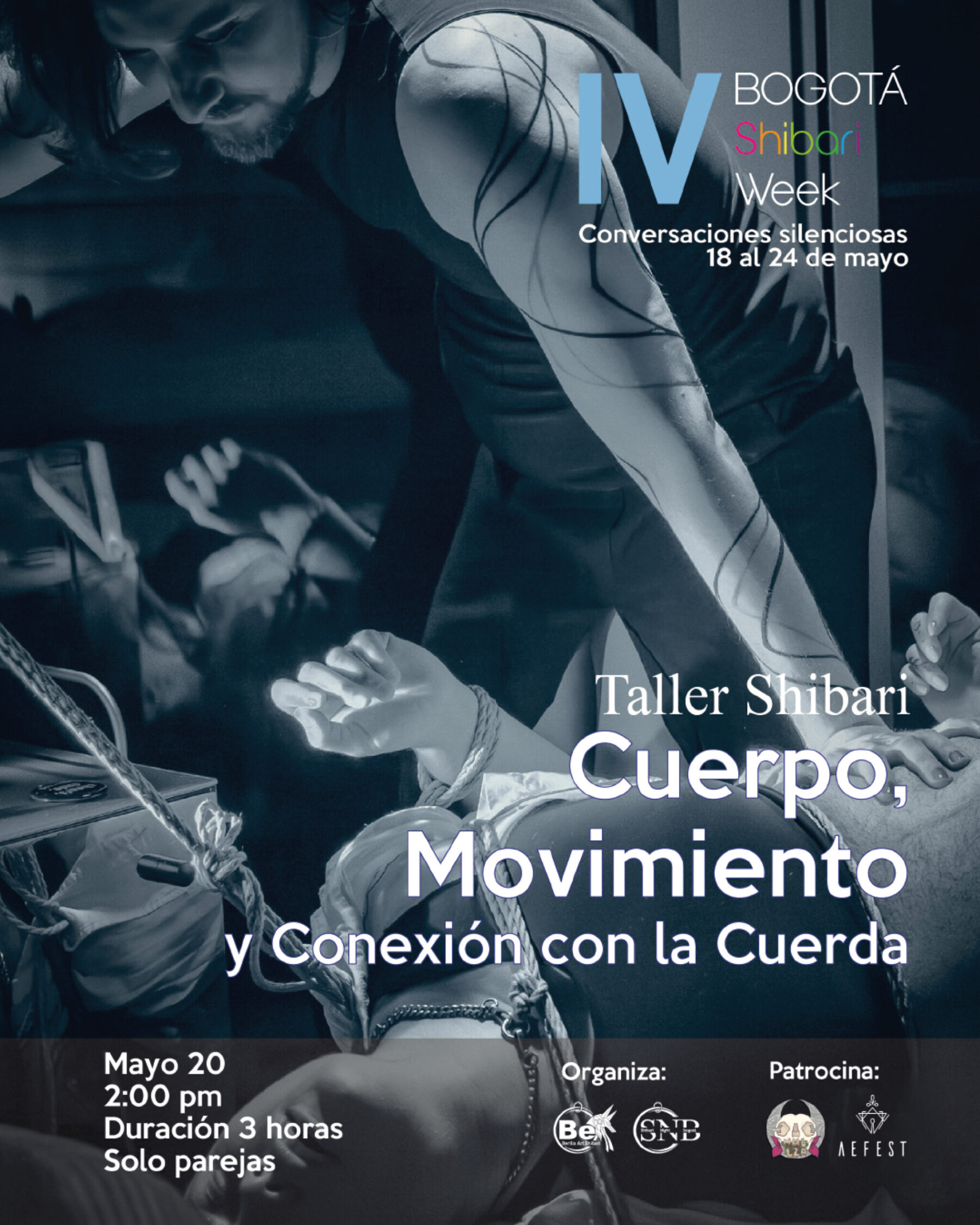
Where I’ll Be
Varieté: Between Pink & Blue · May 18
A performance collaboration with Azul Ropes on opening night. The title says something about where bodies are allowed to exist — between the colors we’re assigned, in the space that’s supposedly empty.
Opening Conversatorio · May 18
¿Cuerpos que conversan sin palabras? — A panel discussion to open the week.
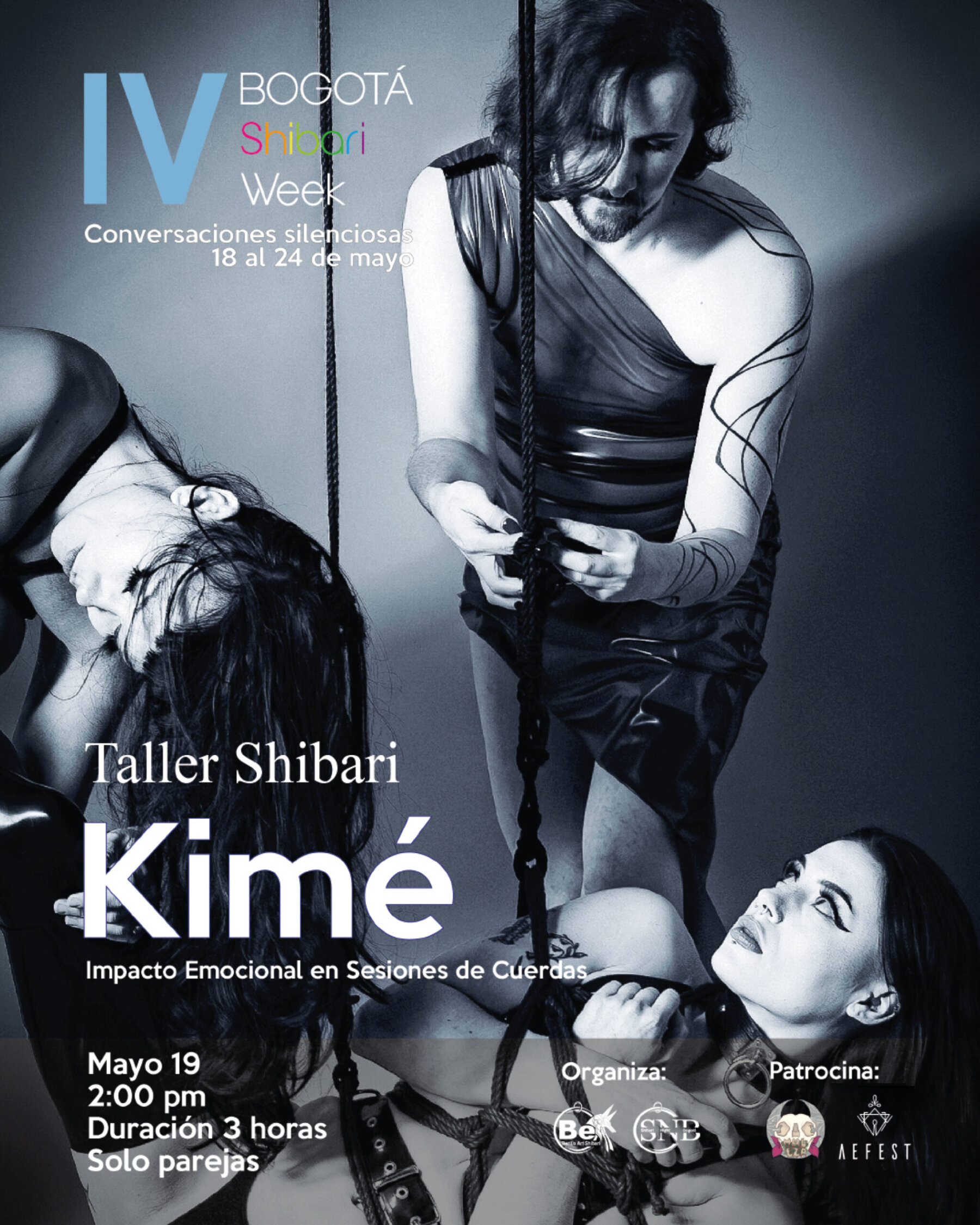
Workshop: Kimé · May 19
Emotional impact in rope sessions. Moments of peak intensity in a session: not necessarily the most extreme physical moment, but the one where something shifts. How do we recognize it? How do we hold it? How do we come back from it?
Workshop: Body, Movement & Rope Connection · May 20
Rope as a sensory and relational system. What does it mean to let the rope moves with a body rather than simply constrain it?
Workshop: Edge & Play · May 20
Erotic exploration through rope — for couples.
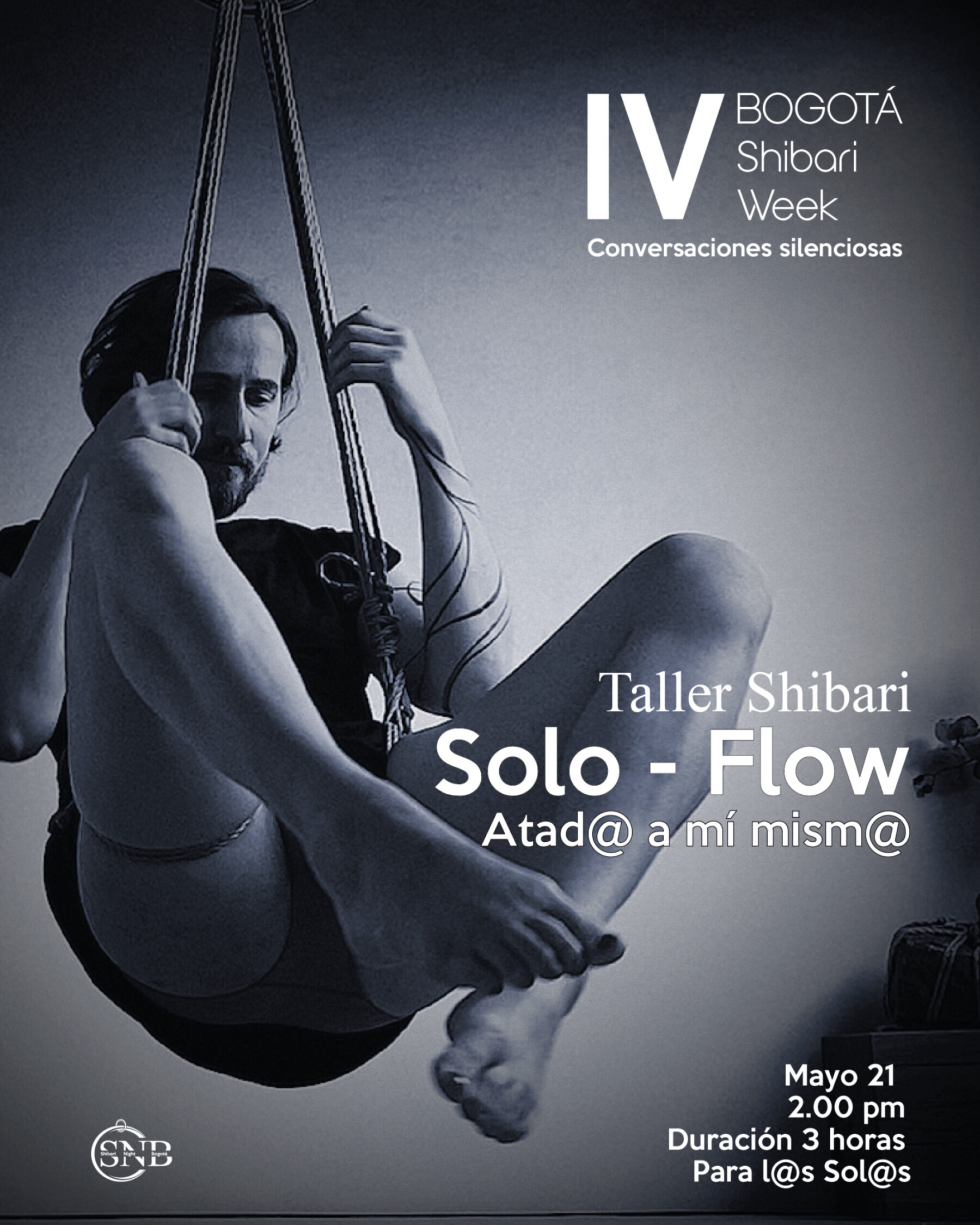
Workshop: Solo-Flow · May 21
Atad@ a mí mism@. Tied to oneself. For participants who come alone — a space for practicing rope as a relationship with your own body, without a partner as intermediary.
Shibari for Photography · May 21
Both sides of the rope. Both sides of the lens.
Rope Triptych — Collaborative Art · May 22
Three perspectives, one visual structure. A collaborative art session that takes rope out of the session context and into something explicitly compositional. Artistically inspired by the cover art work of ’Ritual de lo Habitual‘ from Jane’s Addiction.

Seven Years Later: The Artist & The Pervert
Yesterday, Beatrice Behn showed me that The Artist & The Pervert has its own Wikipedia entry.
Seven years after Beatrice and I made this film, it continues to circulate — screened, cited, discussed. It’s been referenced in academic research on race and BDSM, used in university seminars, and cited alongside work by Jeremy O. Harris in scholarly discourse. This felt like an appropriate moment to pause and reflect on what this project was, what it demanded of us, and what it left behind.
How We Almost Didn’t Make This Film
In 2016, Beatrice saw a New York Times article about composer Georg Friedrich Haas and kink educator Mollena Williams-Haas — their relationship, their artistic practices, their master/slave BDSM contract. They messaged me:
“WE SHOULD MAKE A FILM ABOUT THIS.”
Neither of us had directed a feature-length film or documentary before. I came from advertising — an art director who’d won awards at Cannes. Beatrice was a film critic and editor-in-chief of Germany’s biggest arthouse film portal. We’d made a few experimental short films. That was it.
We messaged Georg on Fetlife (a social network for the BDSM community), figuring they probably wouldn’t get many messages on that platform. They replied immediately. Two weeks later, we started filming.
With a flip camera.
No crew. No lighting equipment. No sound person. Just the two of us, a camera that cost less than €500, and spontaneity. We followed them for a year — New York, Vienna, Hamburg, Schwetzingen, San Francisco, the lonely mountains of Austria. We learned as we went.
The film is 100% independent. Zero budget. Zero funding. We crowdfunded the final post-production — sound mixing and creating DCPs for festival screenings. That was it.
When we began, we didn’t know it was impossible to make a film like this. And it was precisely this not-knowing — paired with a kind of obsessive focus — that made it possible at all.
What we had instead of resources was proximity, trust, and a shared willingness to stay with discomfort.

A Few Learnings From That Time
Certain principles became structural to the process of making the film:
Consent is not a one-time agreement.
Consent had to be revisited before every shoot, every scene. We learned to articulate it verbally, to pause when something shifted, to ask whether a moment felt revealing or extractive, necessary or merely spectacular. We constantly questioned our decisions—what to film, how to frame it, whether we were witnessing or exploiting.
Ethics are inseparable from form.
Every aesthetic decision was also an ethical one. Making a film about BDSM—a practice built on explicit consent—meant our filmmaking process had to embody those same principles. Asking someone to be vulnerable on camera while hiding behind the abstraction of “artistic vision” was never an option. Responsibility could not be outsourced to style.
Representation is never neutral — especially where race is involved.
We were two white German filmmakers making a film about a Black woman in a master/slave dynamic with a white Austrian man with a Nazi background in his family. We continuously questioned how images would circulate once detached from context: who would read them, through which lenses, and with which projections. How do we honor Mollena’s agency while acknowledging the optics? There was no final answer—only ongoing negotiation.
In our Seventh Row interview, Beatrice said:
“We didn’t want to make another freak show film where you can look at them but they can’t look back at you.”
That’s why Mollena breaks the fourth wall in the opening—she stares directly at the camera, at the audience. You’re not just observing her; she’s observing you.

Making a Film on a Zero Budget.
Sometimes, technical limitations force better creative decisions.
We couldn’t afford a large crew, so we were just two people. That meant Georg and Mollena weren’t surrounded by strangers. Intimacy was possible.
We couldn’t afford fancy lighting, so we shot with available light. That meant the film looks like their actual lives, not a stylized version.
We couldn’t afford extensive travel, so we planned carefully. That meant every shoot was intentional.
The flip camera was small and unintimidating. When Georg and Mollena had intimate conversations in their bedroom, they could almost forget we were there. A full cinema crew with lighting rigs and boom mics? That would have changed everything.
The film’s intimacy is inseparable from how we made it.
Would the image quality be “better” with proper equipment? Sure. But would it be more honest? I don’t think so.

The Film’s Unexpected Academic Journey
What we didn’t anticipate was how the film would find its own life beyond festival circuits.
The documentary has been cited in scholarly research across multiple disciplines:
Christa Brüstle, Professor of Musicology and Gender Studies at Kunstuniversität Graz, analyzed the film as part of her research on gender and composition, examining Haas’s connection between his sadism and creativity.
Avgi Saketopoulou used the documentary as an example illustrating how “traumatophilia offers those with trauma a vital and often pleasurable life that goes beyond the prospects of ‘trauma culture’ in which victimhood is the focus.”
And perhaps most significantly: In 2020, Ariane Cruz — author of The Color of Kink: Black Women, BDSM, and Pornography (NYU Press) — cited our documentary as one of three works marking “a juncture in the academic study of race and BDSM.”
The other works she cited were Kinky (dir. Jean Claude La Marre, 2018), Jeremy O. Harris’s Black Exhibition (2019), and Slave Play (written by Harris, directed by Robert O’Hara).
When we were filming in 2016, we never imagined scholars would be citing us in this company. The work we made and published had its own life. It was impossible to predict or control how the audience would perceive it, which conversations it would enter, and which meanings it would accumulate beyond our intentions.
“So, When’s Your Next Film?”
After the world premiere, at every festival, journalists kept asking us: “What’s your next film, now that you have started a filmmaking career?”
Having been relieved of actually having managed to finish this film, we found that question both irritating and frustrating. Who defines what a “career” is? Why does following one documentary with another documentary make more sense than any other path?
Beatrice continued to work in film criticism and editing. I was still working as an art director.
What was more important to us than filmmaking itself: the questions the film had asked.
How can personal experiences being shared honestly with the world change how people think about their lives? How do we create spaces where people can explore power, vulnerability, and intimacy outside conventional scripts? How do we build communities that prioritize consent as an ongoing conversation?
Those aren’t just questions for documentaries. They’re questions for how we live.
The Real Sequel: Karada House
The logical next step, as it turned out, wasn’t another film.
It was co-founding Karada House in Berlin — a queer community space dedicated to Japanese-inspired rope bondage, embodied kink practices, research about sexuality, and the kind of ongoing negotiation and curiosity that the film explored.
In the same way the film held space for complexity around BDSM, consent, and representation, Karada House tries to hold space for people exploring their bodies, their boundaries, and their desires. Kink, politics, and self-discovery are interrogated in the same spirit that the film embodied.
We don’t have the answers. We create the container for people to figure things out for themselves. We prioritize consent as an ongoing conversation. We center queer and trans bodies. We make space for people who don’t fit conventional narratives.
That’s the sequel to The Artist & The Pervert. Not another documentary. A lived practice.

Seven Years Later: What Continues
The film still screens occasionally at film and music festivals — sometimes in anthologies about Georg’s work. It’s available on VOD platforms. It gets cited in academic papers and on Wikipedia.
But the real continuation isn’t the film’s afterlife. It’s the questions it opened up, still being explored — in scholarship, in conversations, in spaces like Karada House, in my own evolving practice.
Currently, I work more with performance, rope art, and photography than filmmaking. But the core remains consistent:
- Bodies as sites where identity, memory, vulnerability, and resistance are enacted
- Creative collaborations as a partnership
- Listening to people instead of assuming
- Creating conditions where unpredictable outcomes can emerge
- Trust and consent as foundational, not optional
And It’s Done! (Or Not Really)
The film ends with Mollena’s last words: “And it’s done!” But it doesn’t conclude. Georg and Mollena’s relationship continues. The questions continue. The conversation continues.
That’s intentional. We didn’t want to wrap things up neatly. Life isn’t neat. Love isn’t neat. Power dynamics aren’t neat.
The film is a year in their lives. A snapshot. A document of a moment in time.
Looking back now, it feels clear that The Artist & The Pervert was less a finished statement than a threshold. Its real continuation unfolded elsewhere: in institutions, in intimate conversations, in subsequent projects shaped by the questions it forced us to confront.
Seven years later, that moment is still reverberating. In academic papers. In Karada House workshops. In my rope practice. In conversations between people trying to figure out how to live ethically, vulnerably, outside convention.
That’s more than we ever hoped for when Beatrice and I started filming.
Maybe that’s the real filmmaker’s career focus: what stories can I tell, and how does it relate to people? Not “what’s the next film?”
The space we created for those questions simply changed form.
Where to Watch & Learn More
The Artist & The Pervert is available on Vimeo (DE), Amazon Prime (EN).
Note: The film is credited to directors Beatrice Behn and René Gebhardt, my legal name under which the film was released, before I started making art as Renée de Sans.
You can also find more information on Wikipedia, IMDb, and in the interviews and reviews listed below.
Related Work
Press & Interviews:
- Seventh Row Interview (2018)
- POV Magazine Review (2018)
- Modern Times Review (2018)
- Deutschlandfunk Kultur (German, 2018)
- FAZ Feuilleton (German, 2020)
